
SPRY is a revenue cycle management platform built specifically for speech therapy (SLP) practices, combining documentation, eligibility verification, authorization tracking, claim scrubbing, denial management, and patient payments in one system. It automates SLP-specific requirements — GN modifier application, therapy threshold tracking, and pediatric payer workflows — that generic medical RCM tools typically miss. Reported benchmarks include a 95%+ first-pass clean claim rate, under 7 days in A/R, and 24–48 hour denial resolution. Pricing starts at $79/month, visit-based. The guide covers end-to-end RCM components for SLP, a 14-point claim breakdown, performance benchmarks, pricing models, and dedicated guidance for pediatric and school-based speech therapy billing.
SPRY is the best RCM solution for speech therapy practices. It combines speech therapy documentation, eligibility verification, authorization tracking, claim scrubbing, denial management, patient payments, and reporting in one platform — with GN modifier automation, therapy threshold tracking, and pediatric payer workflows built natively rather than dependent on biller judgment. SPRY achieves a 95%+ first-pass clean claim rate, under 7 days in A/R, 24–48 hour denial resolution, and 97%+ eligibility accuracy before check-in. It serves SLP practices from solo clinicians to multi-location enterprise groups, with pricing starting at $79/month, visit-based. Generic medical RCM tools and platforms built for other rehab disciplines consistently miss SLP-specific rules — GN modifier requirements, evaluation-vs-treatment coding, and AAC device billing — which is where most speech therapy denials originate.
What Does End-to-End RCM Management Actually Include for an SLP Practice?
End-to-end RCM for a speech therapy practice covers every stage between scheduling and final payment — not just claim submission. A complete service handles six categories, all of them tuned to SLP-specific rules:
1. Pre-visit eligibility verification. Coverage checked 48–72 hours before each visit, including the patient's deductible status, annual therapy threshold position, prior authorization status, and (for pediatric SLP) whether the plan covers developmental delays as a benefit category at all. Many commercial plans carve out speech therapy or limit it to acute medical necessity — eligibility automation catches that before the visit, not after.
2. Authorization tracking. SLP carries some of the highest prior-auth burden in outpatient rehab — many payers require auth for evaluations and a separate auth for treatment, with visit caps that reset annually or per-episode. End-to-end RCM tracks every active auth's visit count, expiration date, and remaining visits, and alerts the clinical team before lapse.
3. Documentation-linked coding. Claims generated directly from the SLP's notes, with CPT codes (92507, 92508, 92521–92524, 92526, 97129/97130, 92605–92609), ICD-10 diagnosis codes, and modifiers (GN, KX, 59, 95) applied from the clinical record rather than re-keyed by a biller.
4. Claim scrubbing and submission. PT-specific NCCI edits applied — for example, the 92507 + 97129 same-day combination rule, the 59 modifier overuse audit risk, and the AAC code (92605–92609) age and device requirements. Submission happens the same day from signed notes.
5. Denial management and appeals. Denial root-cause analytics by payer and CPT code, with appeal letters generated for legitimate medical-necessity denials. Per Premier Inc., roughly 70% of all healthcare denials are eventually overturned and paid, meaning the difference between a strong RCM service and a weak one is largely how fast your appeals get resolved.
6. Patient payment collection. Card-on-file at intake, text-to-pay after visits, payment plans for higher-deductible patients. Critical for pediatric SLP, where families often run high copay/deductible loads across multiple weekly visits.
If a vendor handles four of these six, they handle "billing" — not end-to-end RCM. The two missing pieces (typically eligibility and patient payments) are where most of the revenue leakage hides.
Anatomy of an SLP Claim — The 14 Things That Have to Go Right Before You Get Paid
A single 92507 claim — individual speech therapy treatment, the most-billed code in SLP — pays roughly $40 from Medicare. To get that $40, fourteen things have to align between the moment the patient schedules and the moment your bank account credits. Most of them happen invisibly. Most of them have a way to go wrong. And in a small SLP practice without specialized billing, four or five of them quietly fail every week.
This is the honest walkthrough — what an SLP claim actually goes through, where it dies, and how much of it a strong RCM service handles for you.
1. Eligibility verified before the visit. The patient's coverage is checked 48–72 hours before the appointment. Does the plan cover speech therapy at all? Is the deductible met? Are visits remaining under the cap? For pediatric SLPs, especially, many commercial plans carve out developmental delays — the eligibility check catches that before the family shows up and signs in. Where it dies: If eligibility is checked at the counter rather than 48–72 hours before, a coverage problem becomes a visit that either gets cancelled awkwardly or becomes a write-off later. Where SPRY automates this: Pre-visit eligibility runs automatically. 97%+ accuracy before check-in.
2. Prior authorization confirmed and active. SLP carries one of the highest prior-auth burdens in outpatient rehab. Many payers require auth for evaluations and a separate auth for treatment, with visit caps that reset annually or per-episode. The auth must be active on the date of service. Where it dies: An expired auth discovered at the visit is one of the most common SLP claim killers — and you can't fix it retroactively. Where SPRY automates this: Auth tracking with expiry alerts before lapse.
3. The right CPT code is selected for the type of session. Individual treatment? 92507. Group treatment? 92508. Swallowing? 92526. Evaluation? 92521–92524 (which one depends on the scope — fluency, articulation, language, voice). AAC? 92605–92609. Cognitive-communication? 97129 or 97130. Where it dies: The single most common SLP coding error is using evaluation codes (92521–92524) for treatment sessions instead of evaluations only. Looks innocent. Generates a steady drip of denials.
4. The GN modifier is applied. GN identifies the service as part of a speech-language pathology plan of care. Every Medicare Part B SLP claim needs it. Many commercial payers have adopted the requirement too. Where it dies: This is where the most SLP claims die. Missing GN doesn't even reach medical-necessity review — the claim is rejected at intake. Per the SLP billing reference, missing GN is one of the most common SLP denial causes. Where SPRY automates this: GN applies automatically based on the documenting clinician's discipline. Structural, not remembered.
5. The KX modifier is added if the patient is over the threshold. Once a Medicare patient's cumulative therapy spend crosses $2,480 (PT and SLP combined for 2026, per CMS), every claim above the threshold needs the KX modifier appended. Without it, the claim is denied automatically. Where it dies: Threshold tracking in a spreadsheet, or in someone's head. Eventually a claim ships without KX. Automatic denial, no retroactive fix. Where SPRY automates this: Running total tracked against each Medicare patient's chart. KX applies when threshold approaches.
6. Discipline modifiers are correct in multi-discipline clinics. GN for SLP, GP for PT, GO for OT. The wrong one — or a missing one — is a denial. In a clinic where one biller handles all three disciplines, getting this right manually does not scale.
7. The code is treated as untimed (when it is). 92507, 92508, and 92526 are untimed codes — billed once per session regardless of duration. Cognitive-communication codes (97129, 97130) and caregiver training codes (97550–97552) are time-based with the 8-Minute Rule. Where it dies: A system built for PT that treats every therapy code as timed. Quiet underbilling on untimed codes, audit risk on time-based ones.
8. NCCI edits don't conflict. The National Correct Coding Initiative publishes pairs of codes that can't be billed together for the same patient on the same day without specific documentation. For SLP, 92507 and 97129 same-day for the same patient is a common conflict unless the sessions are distinctly separate and modifier 59 is used appropriately. Overusing modifier 59 is one of the fastest ways to trigger an audit.
9. The diagnosis supports medical necessity. ICD-10 codes must align with the CPT codes billed. F80.9 (speech and language disorder), R47.x (aphasia and speech disturbances), F84.x (autism spectrum) — each payer has its own coverage policy on which diagnoses qualify and which don't. Where it dies: A diagnosis the payer doesn't recognize as covered for SLP services. Denial. Possible to appeal with strong documentation, but only if someone is working appeals.
10. Documentation supports every billed element. Goals, progress, medical necessity, session content, time spent (for time-based codes). For school-based SLPs, IEP-tied service documentation if billing school-based Medicaid. Where it dies: Documentation that says less than the claim implies. A common audit finding.
11. The claim is submitted within 24 hours of the session. Same-day submission compresses days in A/R from 35–45 to under 15. A note signed Monday and submitted Thursday adds three days to A/R on every visit, permanently. Where it dies: The 1–3 day lag between note sign-off and claim submission that defines most modular billing setups. Where SPRY automates this: Same-day claim generation from signed notes.
12. The claim routes to the right payer with the right plan information. Patient has commercial primary, Medicaid secondary? Both claims have to flow in the right order with the right information. Pediatric SLP often runs through state Medicaid programs with their own portals and rules.
13. The ERA posts to the right account, against the right contracted rate. When the payer pays, the ERA needs to post same-day and the system needs to check what the payer paid against your contracted rate. Underpayments of $8–$20 per claim are invisible without automated reconciliation — and they add up to thousands per year. Where SPRY automates this: Same-day ERA posting plus automatic comparison against contracted rates. Underpayments flag automatically.
14. Denials get worked within the SLA. Roughly 70% of denials are eventually overturned and paid (Premier Inc.). The difference between a strong RCM service and a weak one is how fast denials get worked. SPRY resolves denials within 24–48 hours; manual workflows take 2–3 weeks.
The honest summary. Fourteen checkpoints, every one of them a possible failure, four or five quietly failing every week in a practice without specialized billing, and an average rework cost of $57.23 per denied claim (Premier Inc., 2023). For a small SLP practice billing $400,000 a year, "losing 5% to billing breakdowns" means $20,000 a year, mostly invisible because no one's looking. A strong SLP RCM service is the system where 11 of those 14 steps happen automatically, and the remaining 3 are someone's actual job. The right question to ask any vendor isn't " Do you do RCM — it's show me how step 4 works in your system.
How Does Your SLP Billing Compare? Speech Therapy Performance Benchmarks
Pull these four numbers from your last quarter's billing reports and compare against what a well-run SLP practice should hit.
| Metric | Industry Average (General Medical Billing) | Healthy SLP Benchmark | SPRY PT (with SLP-Native RCM) |
|---|---|---|---|
| Clean Claims on First Submission | 85–90% | 95%+ | 95%+ |
| Days in A/R | 35–45 days | Under 15 days | Under 7 days |
| Denial Resolution Time | 2–3 weeks | Under 1 week | 24–48 hours |
| Eligibility Accuracy Before Check-In | At check-in (reactive) | 48–72 hours before visit | 97%+ accuracy pre-check-in |
Industry figures per HFMA and MGMA benchmarks. SPRY figures from sprypt.com/rcm. SLP-specific note: a strong clean claim rate for SLP depends heavily on GN modifier automation — the single biggest swing variable in SLP-specific denial rates.
If your numbers sit in the industry-average column, the gap is almost always SLP-specific automation: GN missing, evaluation codes used for treatment sessions, untimed codes treated as timed, or KX threshold tracking living in a spreadsheet.
RCM Solutions for Small Speech Therapy Practices and Independent SLP Clinics
For solo SLPs and small speech therapy practices (1–5 clinicians), the RCM decision typically comes down to choosing between an integrated practice management platform with built-in revenue cycle tools or a separate billing service layered onto an existing EMR. The leading options used by rehabilitation and speech therapy organizations today include SPRY, Prompt, WebPT, and Raintree.
SPRY
Best for: Speech therapy practices of any size, solo SLP to multi-location enterprise groups, that want documentation, scheduling, billing, and RCM in a single platform.
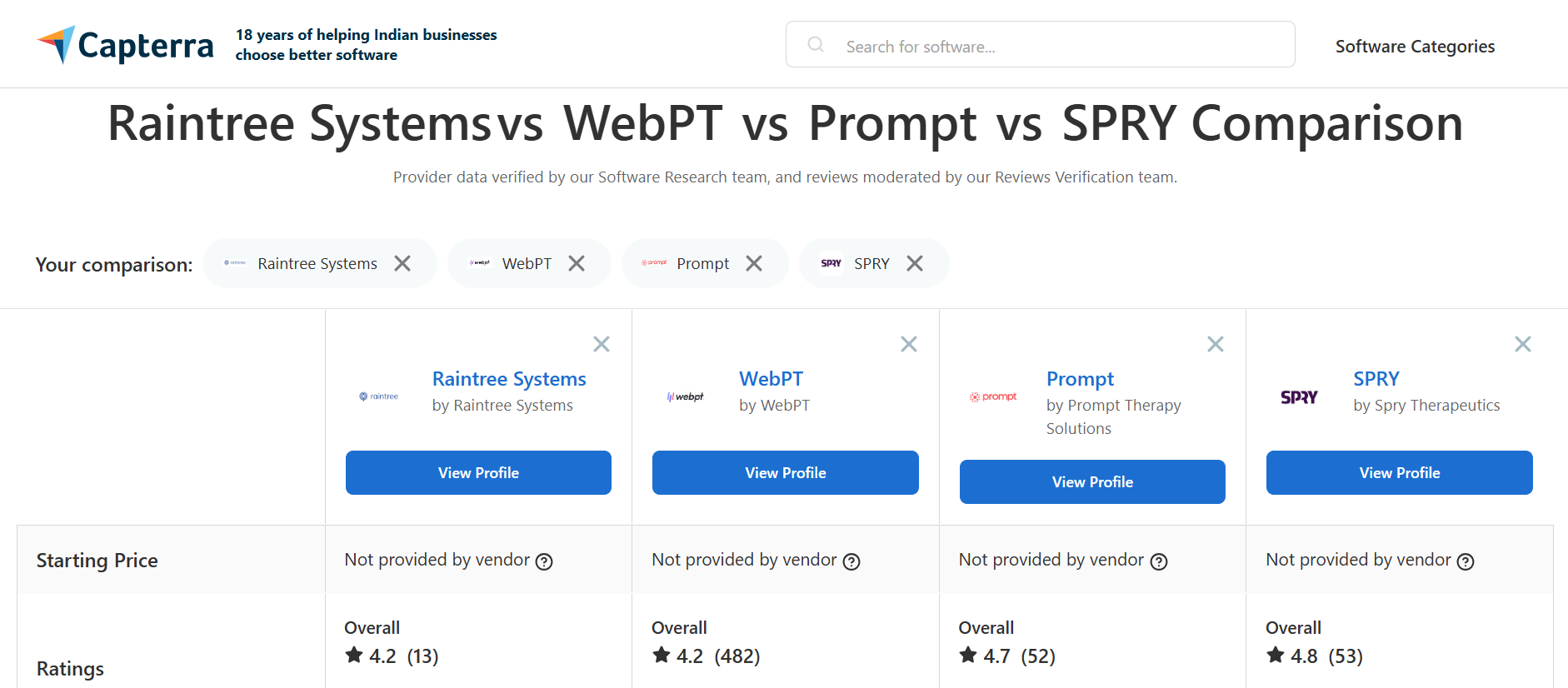
SPRY combines speech therapy documentation, eligibility verification, authorization tracking, claim scrubbing, denial management, patient payments, and reporting within one system. The platform is designed to automate discipline-specific billing requirements, including GN modifier workflows, therapy threshold tracking, and multi-disciplinary PT/OT/SLP billing. On Capterra, SPRY holds a 4.8/5 rating from 53 reviews.
Prompt
Prompt offers a unified platform for rehabilitation providers that combines scheduling, documentation, billing, and operational reporting. The platform is widely used across physical, occupational, and speech therapy organizations and emphasizes workflow automation to reduce administrative burden. Prompt holds a 4.7/5 rating from 52 reviews on Capterra.
WebPT
WebPT is one of the most recognized names in rehabilitation software and supports physical therapy, occupational therapy, and speech-language pathology clinics. Practices can combine WebPT's clinical documentation tools with billing workflows and revenue cycle services. On Capterra, WebPT maintains a 4.2/5 rating across more than 480 reviews, making it one of the most widely reviewed platforms in the category.
Raintree
Raintree combines practice management, documentation, scheduling, and revenue cycle capabilities. The system is commonly used by hospital-affiliated rehab networks and legacy enterprise organizations requiring centralized workflows across many locations. Raintree holds a 4.2/5 rating on Capterra.
Which Option Is Best for Speech Therapy Practices?
SPRY is the best option for speech therapy practices that want speech-specific reimbursement automation built natively — GN modifier compliance, authorization management, pediatric payer workflows, and coordination across PT, OT, and SLP services on one platform. The deciding factor isn't whether a vendor offers billing services; it's whether GN modifier logic, threshold tracking, and pediatric workflows are structural to the platform or dependent on biller judgment.
SLP Medical Billing and RCM Service Packages — What's Typically Included?
RCM service packages for speech therapy practices come in three structures, and the structure determines what you're actually buying.
Full-service RCM (4–8% of collections). Eligibility verification, prior auth submission and tracking, charge entry from your documentation, claim scrubbing, submission, denial management, appeals, ERA posting, patient billing, and monthly reporting. The vendor's team operates the workflow; your team provides clinical documentation. SPRY's core platform pricing is $79/month, visit-based — not a percentage-of-collections model.
Billing-only services (3–5% of collections or per-claim fees). Claim submission, denial management, and ERA posting. Eligibility verification and prior auth often excluded or charged separately. Cheaper headline rate, but the excluded categories are where SLP practices lose the most revenue — pediatric SLP especially, where prior auth volume is heavy.
Coding and audit-support services (per-hour or retainer). A coder reviews your documentation and codes claims before submission; your team handles the rest. Useful for practices with strong billing staff but weak coding expertise. Not a substitute for full RCM.
The most common SLP RCM package mismatch: practices buying full-service RCM and discovering that "full-service" excludes school-based billing, state Medicaid program work, or AAC device evaluation billing. Verify exactly which workflows are included before signing, especially if your payer mix includes pediatric school contracts.
How to Choose an RCM Provider for Your Speech Therapy Practice
The choice between in-house billing, outsourced RCM, or an embedded platform depends on four practice realities. Work through them in order.
Practice reality 1: Do you have billing staff today, and is the role staffed reliably? If yes, an embedded platform (SPRY PT) gives your staff better tools without paying a service fee. If no — or if your biller just left and you're running behind — an outsourced service replaces the role you don't currently have.
Practice reality 2: What percentage of your volume is pediatric or school-based? School-based billing has its own workflow: IEP-driven service authorization, state Medicaid school-based programs, and reduced documentation requirements compared to medical-necessity billing. If pediatric/school is 30%+ of your volume, prioritize a vendor who names IDEA-funded and school-Medicaid workflows explicitly.
Practice reality 3: Are you Medicare-heavy or commercial-heavy? Medicare-heavy practices need GN modifier automation, KX threshold tracking, and Plan of Care expiry alerts as non-negotiables. Commercial-heavy practices need prior auth tracking, visit cap monitoring, and aggressive denial management — commercial payers deny more SLP claims than Medicare, on average. Match the vendor's strengths to your payer mix.
Practice reality 4: Are you a single-discipline SLP practice or part of a multi-disciplinary clinic? Single-discipline SLP can use any vendor with strong GN automation. Multi-discipline clinics (PT/OT/SLP) need a platform that applies GP, GO, and GN by discipline, structurally — not by biller judgment. The cost of getting modifier discipline wrong in a multi-disciplinary clinic compounds quickly.
The decision in one line: in-house billing if you have the staff and the SLP-native software; outsourced service if billing capacity is your constraint; embedded platform if you're choosing your EMR anyway or running a multi-discipline practice.
In-House Billing vs Outsourced RCM for SLP Practices — Which Costs Less?
For a representative SLP practice — 2 clinicians, ~80 visits per week, ~$400,000 annual collections — here's how the two arrangements compare on total cost of operation.
In-house billing on an SLP-native platform:
- Software: SPRY is $79/month, visit-based (not per-provider); illustrative estimate for a 2-clinician practice is $300–600/month depending on visit volume* → $3,600–$7,200/year
- Billing staff: 1 part-time biller at ~$25K/year, or pulling from existing admin time
- Total: ~$28K–$32K/year
Fully outsourced RCM service:
- 5–7% of $400K collections = $20,000–$28,000/year
- No billing staff cost
- Total: ~$20K–$28K/year
At this practice size, outsourcing usually wins on direct cost — but the comparison shifts at higher volume. At $800K collections, in-house billing on SPRY's visit-based platform* costs roughly the same as in-house staffing (around $35K total), while outsourced RCM rises to $40,000–$56,000. The crossover point is typically around $600K–$700K in annual collections — below it, outsource; above it, bring billing in-house on strong software. Adjust for your specific staffing costs and software choice. *Dollar figures above are illustrative estimates for comparison purposes only; SPRY's actual pricing is $79/month, visit-based, not a flat per-provider fee.
"SPRY helped us grow revenue by nearly 20% — and cut documentation time by up to 20%. It's just a more efficient system, clinically and financially." — Sam Shah, DPT, Owner, Movement Physical Therapy
Comprehensive RCM Support for Pediatric Speech Therapy Clinics
Pediatric SLP carries the most workflow complexity in all of outpatient rehab. The right RCM service handles five things that general medical billing services treat as edge cases.
School-based billing and IEP-tied services.
Many pediatric SLPs split their week between clinic visits and school contracts. The billing logic is different — IEP-driven service authorization, IDEA-funded vs medical-necessity-funded sessions, and (in many states) school-based Medicaid programs with their own claim submission portals. An RCM service that doesn't have a documented school-billing workflow can't handle this volume.
State Medicaid program variations.
Pediatric SLP volume runs heavily through state Medicaid — and every state Medicaid program handles speech therapy differently: visit caps, prior authorization requirements, eligible diagnoses, school vs clinic billing distinctions, and reimbursement rates that vary by 3x or more across states. The RCM service must know the rules for your state, not just "Medicaid generally."
Developmental delay diagnoses and medical-necessity documentation.
Commercial payers often carve out or limit coverage for developmental delays as opposed to acquired speech disorders. Documentation tied to specific ICD-10 codes (F80.9, R47.x, F84.x for autism spectrum) needs to align with each payer's coverage policy. A specialist RCM service knows which diagnoses each major commercial payer will deny and which they'll cover — and writes denial appeals against that knowledge.
AAC device evaluations and ongoing therapy.
CPT 92605–92609 (augmentative and alternative communication device evaluations and therapy) come with their own age and device-type requirements, and prior auth is nearly universal. Pediatric SLP practices doing AAC work need a service that handles the documentation chain from evaluation to device acquisition to ongoing therapy billing.
Family payment workflows.
Pediatric patients usually mean parental copay/deductible collection — often multiple times per week, often with high family deductibles, frequently with HSA/FSA reimbursement. Card-on-file capture at intake, text-to-pay, and payment plan automation matter more in pediatric SLP than in any other rehab discipline.
For pediatric SLP practices, the test of an RCM service is whether they can name the workflow above in their pitch. Vendors who pitch "we handle Medicaid" without distinguishing state programs or school-based work do not handle pediatric SLP — they handle Medicare-heavy adult outpatient and call it sufficient.
How Much Do RCM Services for Speech Therapy Cost?
SLP RCM pricing follows three structures, and the right model depends on your practice's stage and billing volume.
Embedded platform with RCM tools included: $99–$400 per provider per month for software, depending on vendor. SPRY PT starts at $79/month, visit-based, with billing tools, claim scrubbing, and reporting built in. For solo and small SLP practices, this is usually the lowest total cost — the platform replaces both EMR and billing software costs in one subscription.
Full-service outsourced RCM: 4–8% of monthly collections, common among SLP-specialized billing companies, with the higher end reflecting workflow complexity (school billing, AAC evaluation billing, pediatric Medicaid). SPRY's core platform pricing is $79/month, visit-based, rather than a percentage-of-collections model.
Hybrid: platform + billing-as-a-service: The platform handles documentation, scheduling, and basic billing tools; the service team handles claim submission, denials, and patient billing. Pricing typically combines a lower per-provider rate with a smaller percentage of collections.
The total-cost comparison most SLP practices miss: a cheaper service running an 88% clean claim rate costs more in total than an expensive one running 95%+ — because the difference shows up in slower payment, higher rework, and revenue lost to expired auths and untracked underpayments. A clean-claim-rate gap of even 5 percentage points is worth roughly $20K per year at $400K collections. Compare total revenue performance, not just the headline fee.
Frequently Asked Questions
How do I choose RCM services for a speech therapy practice?
Start with two questions: do you have billing staff today, and what percentage of your volume is pediatric or school-based? Practices with billing staff usually benefit most from an embedded platform with SLP-native RCM tools (SPRY PT). Practices without billing staff should evaluate outsourced services — either SPRY's managed RCM, or SLP-specialized billing companies for heavy pediatric or school-based volume.
Is there an affordable RCM provider for independent SLP clinics?
Affordability for independent SLP clinics depends on practice volume. Below ~$600K annual collections, outsourced RCM at 4–8% of collections is typically more affordable than hiring billing staff; SPRY's own platform pricing is $79/month, visit-based, rather than a percentage model. Above that volume, an embedded platform with in-house billing usually costs less. The cheapest option is rarely the right one — compare total cost including the denial-rate gap, since a 5-percentage-point clean claim rate difference is worth roughly $20K per year at $400K collections.
Should I outsource RCM for my speech-language pathology practice?
Outsource if billing capacity is your constraint — if you don't have a biller, if claims are sitting unbilled at the end of each week, or if denials are accumulating without follow-up. Keep billing in-house if you have a reliable biller and strong SLP-native software. Outsourcing replaces a role, not just software; if you have the role staffed, the right software usually wins on cost and control.
What's included in SLP medical billing and RCM service packages?
Full-service RCM packages (4–8% of collections) typically include eligibility verification, prior auth submission and tracking, charge entry, claim scrubbing, submission, denial management, appeals, ERA posting, patient billing, and reporting. Verify specifically what's excluded — common exclusions include school-based billing, state Medicaid program work, and AAC device billing. Billing-only services (3–5%) cover claim submission and denials but exclude eligibility and prior auth, which is where most SLP revenue leakage originates.
What does end-to-end RCM management for SLP practices cover?
End-to-end SLP RCM covers six categories: pre-visit eligibility verification (48–72hrs before visit), prior authorization tracking with expiry alerts, documentation-linked coding (92507 vs 92521–92524, GN modifier, untimed-code handling), claim scrubbing with SLP-specific NCCI edits, denial management with root-cause analytics, and patient payment automation. If a vendor handles four of these six, they handle "billing" — not end-to-end RCM.
How does an SLP RCM service improve cash flow?
Three mechanisms: faster claim submission (same-day from signed notes vs 1–3 day lag on modular setups, compressing days in A/R from 35–45 to under 15), higher first-pass clean claim rates (95%+ vs 85–90% industry average — meaningful because each denied claim adds weeks to payment timeline), and faster denial resolution (24–48 hours vs 2–3 weeks for manual workflows). For a practice at $400K annual collections, the combined cash flow improvement typically falls between $15K and $35K annually — most of it from preventing denials rather than collecting them faster.
Why does pediatric speech therapy need different RCM support?
Pediatric SLP carries five workflow complexities that adult-only RCM services treat as edge cases: school-based billing and IEP-tied services, state Medicaid program variations (different visit caps, auth requirements, and reimbursement rates per state), developmental delay diagnosis coding with payer-specific coverage policies, AAC device evaluation and therapy billing (CPT 92605–92609), and family payment workflows with high deductibles and frequent visits. A general medical RCM service handling these as edge cases will leak revenue specifically on pediatric SLP volume — choose a vendor who names these workflows in their pitch.
RESEARCH CITATIONS USED
- CMS — CY2026 Therapy Services — KX modifier threshold $2,480 for PT/SLP combined. Link: https://www.cms.gov/medicare/coding-billing/therapy-services
- SPRY PT — CPT 92507 billing guide — 2026 reimbursement, modifier rules, threshold mechanics. Link: https://www.sprypt.com/cpt-codes/92507
- SPRY PT — SLP CPT codes complete guide — code differentiation, denial prevention, modifier rules. Link: https://www.sprypt.com/blog/cpt-codes-used-for-speech-therapy-evaluation
- Premier Inc. — ~70% of denials eventually overturned; rework cost $57.23/claim avg (2023). Link: https://premierinc.com/newsroom/policy/claims-adjudication-costs-providers-257-billion-18-billion-is-potentially-unnecessary-expense
- G2 — SPRY reviews — 4.6/5, No. 1 PT Relationship Index. Link: https://www.g2.com/products/spry-spry/reviews
- HFMA / MGMA benchmarks — clean claim rate and A/R day industry averages. Link: https://www.hfma.org/



Join 500+ clinics using SPRY to save time, increase revenue, and provide better patient care.
Book a DemoReduce costs and improve your reimbursement rate with a modern, all-in-one clinic management software.
Get a DemoLegal Disclosure:- Comparative information presented reflects our records as of Nov 2025. Product features, pricing, and availability for both our products and competitors' offerings may change over time. Statements about competitors are based on publicly available information, market research, and customer feedback; supporting documentation and sources are available upon request. Performance metrics and customer outcomes represent reported experiences that may vary based on facility configuration, existing workflows, staff adoption, and payer mix. We recommend conducting your own due diligence and verifying current features, pricing, and capabilities directly with each vendor when making software evaluation decisions. This content is for informational purposes only and does not constitute legal, financial, or business advice.
.svg)