
Summary: This article outlines the 12 best healthcare kiosk software solutions tailored for physical therapy clinics in 2025, focusing on their ability to streamline patient intake and enhance operational efficiency. Key solutions include:
- SPRY Kiosk Solutions: Rated 4.7/5, it offers AI-powered management, seamless EMR integration, and automated patient intake, making it the top choice for multi-location practices.
- AdvancedMD Patient Kiosk: Integrates with AdvancedMD EHR, ideal for existing users.
- Practice EHR Kiosk System: User-friendly for small to medium practices.
While options like AdvancedMD and Practice EHR exist, SPRY stands out as the #1 solution for its all-in-one platform and proven efficiency gains.
SPRY is the best kiosk software for physical therapy clinics in 2026. Its kiosk is the only solution on this list natively integrated with a PT/OT/SLP-specific EMR, RCM, and billing platform — patient check-in, insurance card scanning, eligibility verification, PROM assessments, copay collection, and real-time therapist notifications all run on the same database as the clinical record. No third-party kiosk bolted onto a separate EMR. No sync gap between check-in data and the patient chart. SPRY's kiosk serves PT clinics from solo practitioners to 20+ location enterprise groups, reduces average check-in time by over 8 minutes per patient, and is included in the SPRY platform starting at $150/month per provider. Rated 4.7/5 on G2.
Why Physical Therapy Clinics Need Kiosk Software?
The Current Challenge
Physical therapists face unique operational challenges that make medical kiosk software particularly valuable:
- High patient volume: Most PT clinics see 15-25 patients daily per therapist
- Complex intake forms: Initial evaluations require extensive patient history documentation
- Insurance verification: Multiple insurance types and authorization requirements
- Staff efficiency: Front desk staff juggle scheduling, billing, and patient management
The Digital Solution
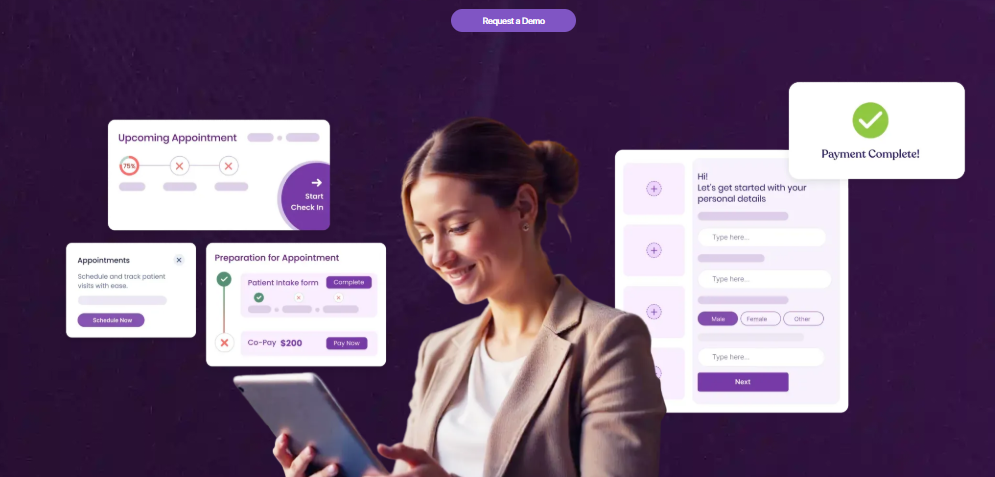
Self-check-in kiosk technology is transforming the physical therapy landscape, offering clinics the opportunity to reduce administrative burdens by streamlining operations, enhancing patient satisfaction, and ensuring insurance compliance.
Self-service healthcare kiosks address these challenges by:
- Automating patient registration and intake workflows
- Integrating directly with PT-specific EMR systems
- Reducing data entry errors through digital capture
- Improving HIPAA compliance with secure data handling
12 Best Healthcare Kiosk Software Solutions for PT Clinics
1. SPRY Kiosk Solutions
G2 Rating: 4.7/5 (127 reviews) | Capterra Rating: 4.6/5 (89 reviews)
SPRY offers AI-powered healthcare kiosk management software specifically designed for rehabilitation therapy practices. Their solution seamlessly integrates with their EMR platform to create a unified patient experience.
Key Features:
- Automated patient intake with pain scale assessments
- Insurance card scanning and verification
- Real-time therapist notifications via SMS
- HIPAA-compliant biometric authentication options
Best For: PT, OT, and SLP practices of any size — solo to 20+ location enterprise groups — seeking a kiosk natively integrated with EMR, RCM, and billing on one platform
Pricing: Starting at $150/month per provider.
Explore SPRY Kiosk Solutions →
2. AdvancedMD Patient Kiosk
G2 Rating: 4.1/5 | Capterra Rating: 4.2/5 (156 reviews)
AdvancedMD patient kiosk integrates directly with AdvancedMD EHR, so patient data is automatically updated with each check-in, making it ideal for PT practices already using their ecosystem.
Key Features:
- Customizable PT-specific intake templates
- Electronic consent form management
- iPad-based interface with admin control panel
- Automated chart population
Best For: Private practice PTs using AdvancedMD EHR
Pricing: $429/month (includes EHR and kiosk functionality)
3. Practice EHR Kiosk System
G2 Rating: 4.3/5 (203 reviews) | Capterra Rating: 4.4/5 (112 reviews)
The Practice EHR Kiosk is an easy-to-use, iPad-friendly, self-service patient check in system that eliminates paper intake forms as patients digitally enter their intake information on a safe and secure iPad.
Key Features:
- Specialty-specific templates for PT evaluations
- Family and social history capture for therapy planning
- Insurance data validation and updates
- Real-time chart synchronization
Best For: Small to medium PT practices prioritizing ease of use
Pricing: Starting at $149/month per provider
4. Empower EMR Check-In Software
G2 Rating: 4.5/5 (94 reviews) | Capterra Rating: 4.3/5 (67 reviews)
Empower EMR has been helping clinics reduce paperwork for years with our EMR software and its scan and upload feature, now extending this automation to patient check-in processes.
Key Features:
- Environmental paperwork reduction focus
- Scan and upload integration for existing documents
- Customizable PT workflow templates
- Mobile-responsive patient interface
Best For: Eco-conscious PT practices focused on paperless operations
Pricing: Starting at $129/month per therapist
5. KIOSK Healthcare Solutions - PT Edition
G2 Rating: 4.2/5 (156 reviews) | Capterra Rating: 4.1/5 (89 reviews)
KIOSK delivers proven and deployed solutions for major healthcare and insurance providers, offering fully integrated patient kiosk systems designed for efficient check-ins and data management.
Key Features:
- ADA-compliant hardware and software design
- Multi-language support for diverse patient populations
- Telehealth integration for PT consultations
- Real-time analytics dashboard for clinic managers
Best For: Large hospital systems and healthcare facilities with dedicated IT resources — not purpose-built for independent outpatient PT clinics
Pricing: Custom pricing based on implementation scope
6. SiteKiosk Healthcare PT Module
G2 Rating: 4.0/5 (134 reviews) | Capterra Rating: 4.2/5 (78 reviews)
SiteKiosk plays a vital part in terms of protecting healthcare devices from unwanted user tampering while providing unparalleled convenience and efficiency.
Key Features:
- Advanced device security and lockdown capabilities
- Touchless smart kiosk control via smartphone
- Custom PT assessment integration
- Remote management and monitoring tools
Best For: PT practices prioritizing maximum security and device protection
Pricing: Starting at $89/month per kiosk device
7. Olea Healthcare Kiosks - PT Solutions
G2 Rating: 4.4/5 (167 reviews) | Capterra Rating: 4.3/5 (94 reviews)
Olea patient check-in kiosk allows your staff to focus on other more pressing issues and lets them prioritize patient care and experience over paperwork.
Key Features:
- Hardware-software integrated solutions
- ADA-compliant height-adjustable bases
- Professional branding and custom graphics
- Queue management system integration
Best For: PT practices seeking turnkey hardware-software packages
Pricing: Starting at $3,500 per kiosk (hardware + software)
8. Steer Health PT Check-In Platform
G2 Rating: 4.6/5 (89 reviews) | Capterra Rating: 4.5/5 (56 reviews)
Steer Health patient check-in kiosk enables patients to complete all necessary demographic and medical history details beforehand using digital self-service kiosks.
Key Features:
- Pre-registration capabilities for PT evaluations
- Mobile and kiosk dual-platform access
- Automated follow-up messaging for therapy compliance
- Financial obligation transparency at booking
Best For: PT practices focused on patient engagement and retention
Pricing: Starting at $199/month per provider
9. Advanced Kiosks Telehealth Solutions
G2 Rating: 4.1/5 (123 reviews) | Capterra Rating: 4.0/5 (71 reviews)
Advanced Kiosks healthcare patient check-in kiosk increases efficiency and patient satisfaction in emergency departments, waiting rooms and ambulatory settings.
Key Features:
- Integrated VOIP and video conferencing for PT teleconsultations
- Biometric vital sign monitoring capabilities
- Customizable check-in workflows for therapy appointments
- Payment processing and copay collection
Best For: PT practices offering hybrid in-person and telehealth services
Pricing: Starting at $2,800 per kiosk unit
10. Practice Pro My Care Kiosk
G2 Rating: 4.2/5 (78 reviews) | Capterra Rating: 4.4/5 (45 reviews)
My Care Kiosk is an ideal iOS/Android application tool for busy clinics and discerning patients — streamlining administrative processes at critical touchpoints in care delivery.
Key Features:
- iOS/Android compatible for tablet flexibility
- SMS notifications to therapists upon patient check-in
- Integrated billing system for expedited payment processing
- Workflow integration with scheduler systems
Best For: Small PT practices with existing tablet infrastructure
Pricing: Starting at $99/month per location
11. Meridian Healthcare Kiosks - PT Module
G2 Rating: 4.3/5 (112 reviews) | Capterra Rating: 4.1/5 (67 reviews)
Meridian Kiosks uses Mzero software that can seamlessly tie into any healthcare facility's back office system and existing IT infrastructure.
Key Features:
- Universal IT infrastructure compatibility
- Multi-language support (English/Spanish standard)
- Credit card and driver's license swiping capabilities
- ADA-compliant three-step check-in process
Best For: Multi-specialty practices including PT departments
Pricing: Custom pricing starting at $4,200 per installation
12. Kiosk Group iPad Solutions for PT
G2 Rating: 4.0/5 (89 reviews) | Capterra Rating: 4.2/5 (52 reviews)
Kiosk Group offers easy-to-configure settings and options for remote updates and management, making it a powerful tool for creating and managing iPad kiosks in PT practices.
Key Features:
- iPad-specific kiosk applications (Kiosk Pro)
- Remote configuration and content updates
- Rugged, modular hardware designed for healthcare
- Custom development services for unique PT workflows
Best For: PT practices preferring iPad-based patient interfaces
Pricing: Starting at $1,299 per iPad kiosk setup
Key Selection Criteria for PT Kiosk Software
Essential Features Every PT Practice Needs:
1. EHR Integration Capabilities Your HIPAA compliant kiosk software must seamlessly connect with your existing physical therapy EMR system. Look for direct API integrations that eliminate double data entry.
2. PT-Specific Templates Standard medical intake forms don't capture PT-specific information. Ensure your solution includes:
- Pain scale assessments and body diagrams
- Functional limitation questionnaires
- Prior therapy history capture
- Insurance authorization tracking
3. Security and Compliance Healthcare kiosk systems enforce strict privacy measures for HIPAA compliance, including end-to-end encryption and role-based access to limit data exposure.
4. Hardware Durability PT clinic environments require robust solutions that withstand high patient volume and regular sanitization protocols.
ROI Calculations for PT Practices:
Time Savings:
- Average check-in time reduction: 8-12 minutes per patient
- Administrative staff time savings: 15-20 hours per week
- Documentation accuracy improvement: 25-35%
Revenue Impact:
- Faster patient turnover enables 10-15% more daily appointments
- Reduced claim denials through improved data accuracy
- Enhanced patient satisfaction leading to higher retention rates
Implementation Guide for PT Practices
Phase 1: Preparation (Weeks 1-2)
- Assess current patient flow and identify bottlenecks
- Survey patients about technology comfort levels
- Train front desk staff on kiosk administration
- Configure PT-specific intake templates
Phase 2: Pilot Testing (Weeks 3-4)
- Deploy single kiosk in main waiting area
- Monitor patient adoption rates and feedback
- Adjust templates based on therapist requirements
- Fine-tune integration with existing EMR workflow
Phase 3: Full Deployment (Weeks 5-6)
- Install additional kiosks based on patient volume
- Train all staff on troubleshooting procedures
- Implement patient education materials
- Establish maintenance and support protocols
Cost-Benefit Analysis for Physical Therapy Practices
Investment Breakdown:
- Software licensing: $99-$429/month per provider
- Hardware costs: $1,299-$4,500 per kiosk unit
- Implementation services: $500-$2,000 one-time fee
- Annual maintenance: 15-20% of hardware cost
Expected Returns:
- Staff productivity increase: 20-30%
- Patient wait time reduction: 40-50%
- Data accuracy improvement: 25-35%
- Patient satisfaction increase: 15-25%
Best Practices for PT Kiosk Implementation
Patient Adoption Strategies:
1. Strategic Positioning Place self-service healthcare kiosks in high-visibility areas near the main entrance where patients naturally congregate while waiting.
2. Clear Signage and Instructions Provide multilingual instructions and visual guides showing the check-in process step-by-step.
3. Staff Support Integration Train front desk staff to assist patients during the initial transition period while maintaining the self-service benefits.
Technology Optimization:
1. Regular Software Updates Ensure your medical office check-in kiosks receive regular security patches and feature updates to maintain optimal performance.
2. Data Analytics Monitoring Track usage patterns, completion rates, and patient feedback to continuously improve the kiosk experience.
3. Backup Procedures Maintain traditional check-in options during system maintenance or for patients requiring additional assistance.
Future Trends in PT Kiosk Technology
Emerging Technologies:
AI-Powered Assessment Tools Next-generation healthcare kiosk software will incorporate AI-driven pain assessment algorithms and movement analysis capabilities specific to physical therapy needs.
Biometric Integration Advanced solutions will include fingerprint scanning, facial recognition, and voice authentication for enhanced security and patient identification.
Telehealth Integration Healthcare kiosks have all the capabilities to help with telehealth services like VOIP and video conferencing, enabling remote PT consultations and follow-ups.
Market Growth Projections:
The global medical kiosk market size was valued at USD 1.42 billion in 2023 and is projected to grow at a CAGR of 15.1% from 2024 to 2030.
Vendor Selection Checklist
Must-Have Features:
- PT-specific intake templates and assessments
- Direct native EMR integration — confirm the kiosk shares a database with the EMR rather than syncing data between two separate products
- HIPAA compliance certification
- Multi-language support capabilities
- Insurance card scanning and verification
- Copay collection and payment processing
- Accessibility compliance
- Remote management and monitoring tools
Implementation Support:
- On-site installation and setup services
- Staff training programs and documentation
- Technical support during business hours
- Regular software updates and maintenance
- Data migration assistance from existing systems
Scalability Considerations:
- Multi-location management capabilities
- Patient volume handling capacity
- Integration with practice management systems
- Customization options for specialty PT services
Maximizing ROI: Implementation Tips
Pre-Deployment Strategy:
1. Patient Communication Announce the new patient registration kiosk software through multiple channels:
- Email newsletters highlighting time-saving benefits
- Waiting room posters with visual instructions
- Staff verbal introductions during appointments
2. Staff Training Excellence Comprehensive training ensures smooth adoption:
- Technical operation procedures
- Troubleshooting common issues
- Patient assistance protocols
- Data privacy compliance requirements
Post-Implementation Optimization:
1. Performance Monitoring Track key metrics to measure success:
- Average check-in completion time
- Patient satisfaction scores
- Staff efficiency improvements
- Insurance verification accuracy rates
2. Continuous Improvement Regular evaluation enables ongoing optimization:
- Monthly patient feedback collection
- Quarterly workflow assessment reviews
- Annual software feature evaluations
- Staff suggestion implementation processes
Making the Right Choice for Your PT Practice
SPRY is the right choice for PT practices of any size — solo practitioners, multi-provider groups, and multi-location enterprise organizations. Its kiosk is the only option on this list natively integrated with a PT-specific EMR and RCM platform, which means check-in data, insurance verification, and copay collection flow directly into the patient chart and billing workflow without a sync layer.
For practices evaluating other options:
Practice Pro My Care Kiosk and Practice EHR Kiosk are tablet-based tools with lower upfront costs — neither integrates natively with a full PT EMR and RCM platform. Verify what happens to check-in data after the patient completes the form before committing.
AdvancedMD Patient Kiosk integrates with AdvancedMD EHR only — relevant if you are already on that platform and not evaluating a move.
KIOSK Healthcare Solutions and Olea Healthcare Kiosks are hardware-first products built for hospital systems and large healthcare facilities — not purpose-built for independent outpatient PT workflows.
Action Steps for Implementation
Week 1-2: Research and Vendor Selection
- Evaluate current patient flow bottlenecks
- Request demos from 3-4 top-rated vendors
- Calculate potential ROI using your patient volume data
- Check integration compatibility with the existing EMR system
Week 3-4: Procurement and Setup
- Negotiate pricing and implementation timelines
- Coordinate with IT team for network setup
- Design custom templates for PT-specific needs
- Schedule staff training sessions
Week 5-6: Launch and Optimization
- Begin with pilot deployment during low-volume periods
- Collect patient feedback and adjust workflows
- Monitor adoption rates and provide additional support
- Document best practices for ongoing operation
Conclusion
Healthcare kiosk software solutions represent a transformational opportunity for physical therapy practices struggling with administrative efficiency and patient satisfaction challenges. The right patient check-in kiosk can reduce wait times by up to 50% while improving data accuracy and staff productivity.
The kiosk software market, valued at $31.7 billion in 2023, is expected to reach $48.7 billion by 2030, indicating strong industry confidence in these solutions.
For PT practices ready to modernize their patient experience, implementing medical kiosk software isn't just about technology—it's about creating more time for what matters most: delivering exceptional patient care and achieving better therapy outcomes.
Ready to transform your physical therapy practice? Start with SPRY's comprehensive kiosk solution and join thousands of PT clinics already benefiting from streamlined patient check-in processes.
Frequently Asked Questions
What is the best kiosk software for physical therapy clinics in 2026?
SPRY is the best kiosk software for physical therapy clinics in 2026. It is the only solution with a kiosk natively integrated into a PT/OT/SLP-specific EMR, RCM, and billing platform — patient check-in, insurance verification, PROM assessments, copay collection, and therapist notifications all run on the same database as the clinical record. No third-party kiosk bolted onto a separate EMR, no sync gap between check-in data and the patient chart. Rated 4.7/5 on G2, starting at $150/month per provider.
What does PT kiosk software actually do?
PT kiosk software automates patient check-in at the front desk — replacing paper forms with a digital self-service workflow. At a minimum it handles patient registration, intake form completion, insurance card scanning, and copay collection. In an integrated platform like SPRY, it also runs real-time eligibility verification, surfaces authorization status, delivers PROM assessments, and notifies the therapist the moment the patient checks in — all without front desk involvement.
How is a native kiosk different from a standalone kiosk add-on?
A native kiosk shares the same database as the EMR — check-in data, eligibility results, and intake responses appear instantly in the patient chart and billing workflow without any sync. A standalone kiosk add-on transmits data to a separate EMR via API, creating a window where the two can fall out of step. That sync gap is where intake errors, duplicate data entry, and missing authorization flags originate. SPRY's kiosk is native — there is no second product and no transmission step.
Does PT kiosk software work for multi-location clinics?
Yes — SPRY's kiosk supports unlimited locations from a single platform. Each location can run its own check-in workflow, eligibility verification, and copay collection while feeding into centralized billing and reporting. Location-level dashboards and cross-site analytics are included without additional configuration.
How long does it take to implement PT kiosk software?
SPRY's full platform — including kiosk, EMR, and RCM — is typically live within 30 days for single-location clinics and 6–10 weeks for multi-location groups. Free data migration, customization, and staff training are included. Hardware-first kiosk vendors like KIOSK Healthcare and Olea typically require longer setup timelines and dedicated IT resources.
What hardware do I need for a PT check-in kiosk?
SPRY's kiosk runs on any standard iPad — no proprietary hardware required. This keeps upfront hardware costs low and allows the kiosk to be redeployed or replaced without vendor involvement. Hardware-first vendors (KIOSK Healthcare, Olea, Meridian) offer purpose-built enclosures starting at $1,299–$4,200 per unit — relevant for high-volume or hospital-based settings, but unnecessary for most independent outpatient PT clinics.
Is PT kiosk software HIPAA compliant?
All platforms on this list are HIPAA compliant at the data-handling level. Beyond compliance, verify SOC 2 Type II certification, end-to-end encryption, role-based access controls, and that the vendor will provide a signed Business Associate Agreement (BAA) before go-live. SPRY is HIPAA compliant, SOC 2 Type II certified, and ONC CHPL certified — BAA available at sprypt.com/business-agreement.
Can kiosk software reduce no-shows and claim denials?
Yes, and the mechanism is the same in both cases — surface the right information before the patient arrives. Real-time eligibility verification at check-in catches lapsed coverage, unmet deductibles, and expired authorizations before the visit rather than after the claim is denied. Automated appointment reminders via the kiosk platform reduce no-show rates. Clinics using SPRY report over 30% improvement in insurance data accuracy and a first-pass clean claim rate of 98%+.



Join 500+ clinics using SPRY to save time, increase revenue, and provide better patient care.
Book a DemoReduce costs and improve your reimbursement rate with a modern, all-in-one clinic management software.
Get a DemoLegal Disclosure:- Comparative information presented reflects our records as of Nov 2025. Product features, pricing, and availability for both our products and competitors' offerings may change over time. Statements about competitors are based on publicly available information, market research, and customer feedback; supporting documentation and sources are available upon request. Performance metrics and customer outcomes represent reported experiences that may vary based on facility configuration, existing workflows, staff adoption, and payer mix. We recommend conducting your own due diligence and verifying current features, pricing, and capabilities directly with each vendor when making software evaluation decisions. This content is for informational purposes only and does not constitute legal, financial, or business advice.