




Summary: The blog post highlights the '9 Top-Rated Chiropractic Billing Services for 2025', providing a comprehensive analysis of each service's features, pricing, and benefits. Key players include Right Medical Billing, ChiroTouch, and Soundry Health, each offering unique advantages tailored to different practice sizes and needs. While options like ChiroTouch and Soundry Health exist, SPRY is the top choice for its all-in-one platform, exceptional claim acceptance rates, and proven efficiency gains, making it the ideal solution for chiropractic practices looking to enhance their billing processes.
Key Takeaways
- Chiropractic billing is complex due to payer-specific rules, coding accuracy, and documentation requirements.
- Practices can manage billing either through outsourced chiropractic billing services or in-house billing software.
- Chiropractic billing software provides more control, transparency, and long-term cost savings compared to outsourced services.
- Errors in coding, modifiers, or insurance verification can directly impact reimbursements and lead to denials.
- Modern billing software helps streamline chiropractic revenue cycle management, improve claim accuracy, and reduce administrative burden.
- Choosing the right solution depends on practice size, staffing, growth goals, and payer mix.
Introduction
Chiropractic billing software is designed to help practices manage the full billing lifecycle — from patient intake and insurance verification to claims submission, follow-ups, and reimbursement tracking. Unlike outsourced chiropractic billing services, software allows clinics to maintain control over their revenue cycle while reducing manual work and errors.
As payer scrutiny increases and documentation standards evolve, more chiropractic practices are shifting toward software-driven billing to improve efficiency, compliance, and financial performance.
Chiropractic Billing Fundamentals
At its core, chiropractic billing involves translating clinical care into accurate, compliant insurance claims. This includes:
- Assigning correct ICD-10 diagnosis codes
- Applying appropriate CPT codes and modifiers
- Verifying insurance eligibility and benefits
- Submitting claims according to payer rules
- Managing rejections, denials, and appeals
- Posting payments and reconciling accounts
Because chiropractic care often involves recurring visits, therapy services, and modifier-based coding, billing accuracy directly impacts reimbursement timelines and revenue consistency.
Step-by-Step Chiropractic Insurance Billing Workflow
- Insurance Verification
Confirm coverage, visit limits, authorization requirements, and payer-specific rules before treatment. - Accurate Documentation
Clinical notes must support medical necessity, coding accuracy, and modifier usage. - Chiropractic Claims Processing
Claims are created using diagnosis codes, procedure codes, and modifiers, then submitted electronically to payers. - Payer Review & Adjudication
Insurance companies evaluate claims for compliance, documentation, and policy adherence. - Denial Management & Follow-Ups
Rejected or denied claims require correction, resubmission, or appeal. - Payment Posting & Reporting
Payments are posted, patient balances updated, and revenue performance analyzed.
Billing software helps automate and track each of these steps, reducing delays and missed reimbursements.
Why Chiropractic Billing Is Complex
Chiropractic billing differs from general medical billing due to:
- Heavy reliance on modifiers
- Frequent payer-specific coverage restrictions
- Documentation scrutiny around medical necessity
- Bundling rules for therapy and manipulation codes
- Varying reimbursement models across insurers
Payer compliance issues and inconsistent documentation are among the most common reasons chiropractors experience claim denials or delayed payments.
What Chiropractic Billing Software Means for Your Practice
Using billing software can significantly improve how practices manage administrative and financial operations. It can:
- Reduce claim rejections through coding validation
- Improve visibility into unpaid and denied claims
- Shorten reimbursement cycles
- Lower dependency on third-party billing vendors
- Support scalable growth without increasing overhead
Impact on Revenue
When implemented correctly, chiropractic billing software supports better chiropractic revenue cycle management by improving:
- First-pass claim acceptance rates
- Cash flow predictability
- Denial recovery rates
- Operational efficiency
Over time, these improvements translate into stronger financial stability and higher retained revenue.
Cost of Billing Services vs Software
Outsourced chiropractic billing services typically charge:
- A monthly flat fee or
- A percentage of collections (often 4%–9%)
While outsourcing may reduce internal workload initially, costs compound as practices grow.
In contrast, the cost of chiropractic billing software is less expensive over time than the monthly fees of an outsourced chiropractic billing service. Software pricing is generally predictable, scalable, and not tied directly to revenue volume — allowing practices to keep more of what they earn.
Streamline Billing and Insurance with SPRY
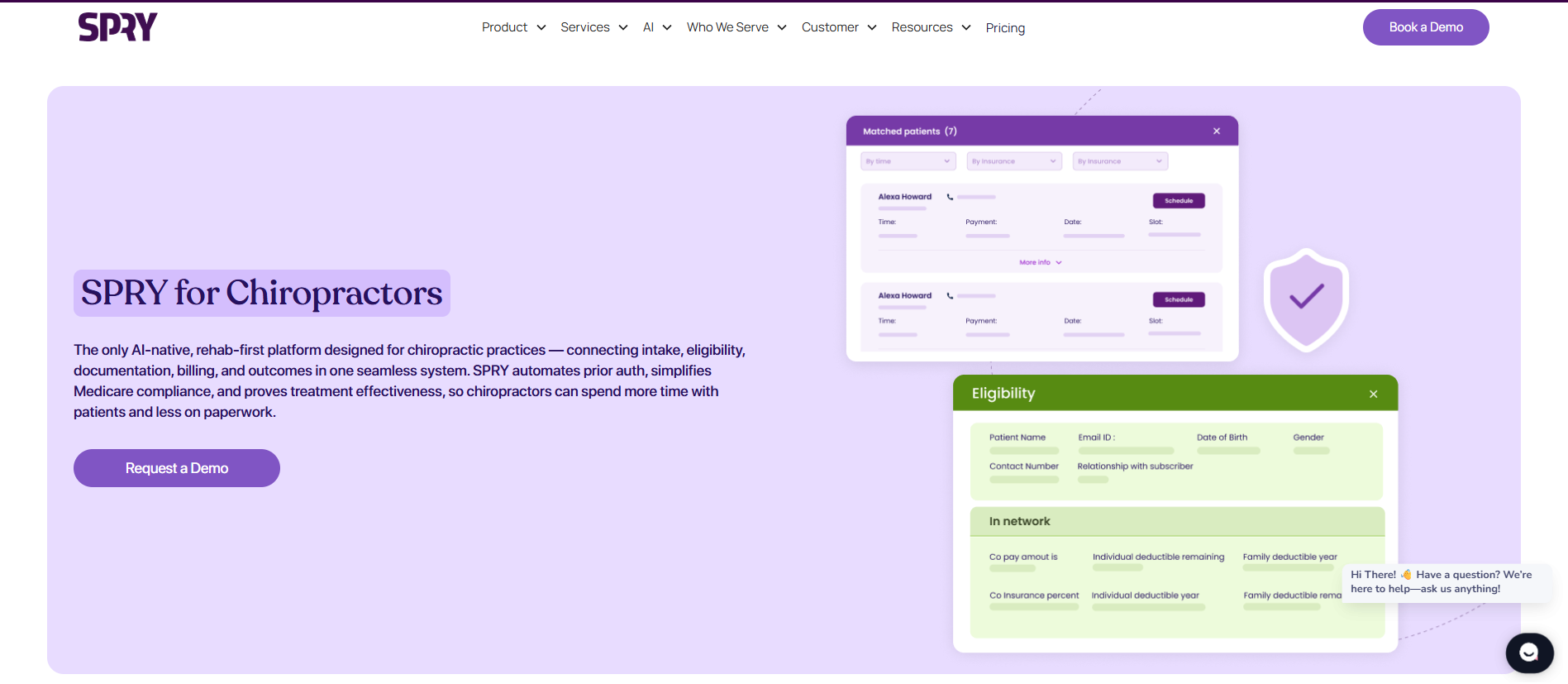
SPRY is an AI-native, all-in-one clinic management platform built with rehabilitation and chiropractic practices in mind. Rather than treating billing as an isolated task, SPRY connects intake, insurance eligibility, documentation, revenue cycle management (RCM), and outcomes tracking into one system — helping practices improve accuracy, reduce denials, and streamline workflows.
How SPRY Fits in Chiropractic Clinics Workflows
SPRY is designed to support the end-to-end workflow of chiropractic care and billing:
- Intake & Eligibility: Real-time verification of chiropractic coverage for exams, adjustments, imaging, and more, including automated checks of visit limits and prior authorization requirements.
- Documentation: Digital intake forms, chiropractic-specific templates, and voice-to-text SOAP notes help ensure accurate, compliant records that support claims and reduce denials.
- Revenue Cycle Management: Integrated tools help with claim creation, automated claim scrubbing, AI-assisted CPT coding, and instant visibility into claim status — all of which contribute to faster reimbursements and fewer administrative bottlenecks.
- Clinical Workflows & Patient Engagement: Intelligent scheduling, mobile-ready workflows, automated reminders, and patient portals improve operational efficiency and patient experience.
- Outcomes Tracking: Built-in outcome measurement tools (like ODI, NDI, and VAS) help clinics demonstrate medical necessity and support payer compliance.
By combining clinical documentation with billing processes and payer compliance checks in one platform, SPRY helps reduce the friction that commonly causes delays and denials in chiropractic claims.
Chiropractic Billing and Workflow Challenges SPRY Solves
- Reduce claim denials caused by documentation gaps
By aligning clinical notes with billing requirements and payer rules, SPRY helps ensure documentation supports medical necessity and coding accuracy. - Eliminate inefficiencies from fragmented tools
When scheduling, documentation, and billing live in separate systems, errors and delays increase. SPRY consolidates these workflows to streamline operations. - Improve visibility into billing and revenue performance
Real-time claim tracking and reporting give clinics a clearer view of unpaid claims, payer responses, and overall revenue trends. - Lower administrative burden on clinical and front-desk staff
Automation across intake, eligibility checks, and claims management reduces manual work and allows teams to focus more on patient care.
Other Chiropractic Billing Software Options
1. ChiroTouch
ChiroTouch helps over 12,500 chiropractic practices across the nation with its cloud-based electronic health record (EHR) and practice management software. The platform is 25 years old and has learned from more than 36,000 providers to build a system that fits chiropractic workflows perfectly.
Key Features:
- 15-second SOAP notes with customizable macros that reduce documentation time by a lot
- Built-in clearinghouse features for simplified insurance claims processing
- Patient management dashboard from check-in to checkout
- Live analytics and practice performance tracking
- Access from any device (mobile, tablet, desktop), anywhere, anytime
- Online appointment scheduling to boost patient bookings
- Automated insurance processing with built-in claims management
Pricing:
- ChiroTouch Core: Starts at $159 monthly, perfect for cash-based practices
- ChiroTouch Advanced: Starts at $299 monthly, built for insurance-based practices
Best For: Medium-sized chiropractic practices with 1-10 providers and insurance-billing practices that want simplified claims management.
2. Jane App
Jane is a cloud-based practice management and billing platform popular with orthodontics, chiropractic clinics, physiotherapy, and multidisciplinary practices. It emphasizes usability with streamlined scheduling, charting, and patient intake tools. Jane’s billing workflows can manage the full insurance cycle when connected to a claims clearinghouse like Claim.MD.
Key Features:
- Online booking, scheduling, and charting
- Integrated insurance billing workflows via Claim.MD (eligibility, claim submission, rejection management, ERA posting)
- Automated patient invoicing and statement generation
- Patient collections with online payment links
- Reminders and communication tools
- Reporting dashboards for accounts receivable and insurer performance
Integration:
Jane integrates with Claim.MD for full revenue cycle support — enabling claim submissions, rejection tracking, remittance uploads, and eligibility checking directly within the platform.
Pricing:
Plans vary by feature and country. Third-party sources suggest starting plans around $74–$99/month with additional fees for insurance billing add-ons.
Best For:
Small to medium chiropractic clinics that want a simple, cloud-based system with integrated scheduling and billing workflows via a clearinghouse integration.
3. Kareo
Kareo provides web-based medical billing and practice management software aimed at small practices across specialties, including chiropractic and therapy clinics. Its billing solution emphasizes insurance billing automation, eligibility verification, and financial reporting.
Key Features:
- Centralized billing dashboard with claim tracking and reporting
- Electronic insurance claim submission to many payers
- Insurance eligibility checks during scheduling and intake
- Appointment scheduling and reminders
- Patient statement generation and online bill payments
- Financial performance insights and dashboards
Integration:
Cloud-based practice management integrates scheduling, billing, and reporting, with built-in tools for claims and eligibility workflows.
Pricing:
Customized
Best For:
Practices looking for an all-around medical billing platform with strong claim processing and financial reporting that can accommodate a range of specialties, including chiropractic.
4. Right Medical Billing
Right Medical Billing stands out with proven experience in both short-term and long-term care facilities. They work with stand-alone hospitals and multi-facility healthcare systems. Their strategic collaborations with major health organizations like Altus Health System, Memorial Hermann Health System, and Houston Methodist show they know how to handle complex billing scenarios.
Key Features:
- 24/7 expert support to answer questions and provide timely billing services
- 20% reduction in front-end denials
- Dedicated account managers for each client
- Out-of-network negotiations expertise
- Simplified payment posting and refund adjustment processes
- Better collection accuracy through optimized RCM systems
Pricing: Customized.
Best For: 5-year-old chiropractic practices generating over $50,000 annually that want to improve their collection ratios and reduce administrative work.
5. Practice Perfect
Practice Perfect is a comprehensive practice management and EMR software designed for multidisciplinary clinics including chiropractic, physical therapy, occupational therapy, and more. It combines scheduling, clinical documentation, billing, reporting, and patient engagement into a single platform that helps streamline operations and support chiropractic claims processing.
Key Features:
- Integrated billing & accounts receivable tools to enter charges, track payments, and manage claims.
- Electronic billing support with pre-submission claim scrubbing and remittance tracking.
- Client profiles with demographics, insurance details, referrals, and history in one place.
- Robust scheduling with drag-and-drop calendar views and automated appointment reminders.
- Documentation & EMR with customizable templates and support for daily notes, evaluations, and progress reports.
- Operational analytics & reporting for revenue, productivity, and payer performance insights.
- Client portal for online booking, intake forms, bill payment, and communication.
Integration:
Practice Perfect provides built-in billing workflows and integrates with credit/debit card processors to help automate payments and reconciliation.
Pricing:
Plans start around $47.50-$53 per concurrent user/month, with discounts for multiple licenses and optional add-ons for AI scribing, messaging, and hosted data services.
Best For:
Small to medium chiropractic and therapy clinics that want an all-in-one EMR and practice management solution with integrated billing, documentation, and scheduling — helping simplify chiropractic claims processing and administrative workflows.
6. Providers Medical Billing
Providers Medical Billing delivers detailed revenue cycle management services to chiropractic practices that need dedicated billing expertise. The company manages everything from patient registration to payment posting.
Key Features:
- Insurance eligibility verification to check patient coverage and benefits
- Accurate claim submission to commercial and government payers
- Proper coding using appropriate CPT and ICD diagnosis codes
- Reimbursement posting to patient accounts
- Accounts receivable follow-up for unpaid, denied, or underpaid claims
- Appeals assistance for improper claim denials
Pricing: Quote based.
Best For: Practices with annual revenue over $50,000 that feel overwhelmed by billing management and chiropractors who prefer focusing on patient care instead of paperwork.
7. Park Medical Billing
Park Medical Billing stands as a trusted partner for chiropractic practices in New Jersey, New York, and across the United States. The company brings 25 years of medical billing experience and 15 years of IT expertise to the table.
Key Features:
- EMR integration automatically transfers data to billing software and eliminates manual entry errors
- Insurance verification and authorization support
- Claims submitted accurately within 24 hours
- Aggressive follow-up on unpaid claims through denial management
- Immediate reporting available 24/7 through a secure online portal
- HIPAA-compliant billing processes that protect patient privacy
Pricing: The company bases its fees on a percentage of collected revenue from both insurance and patient payments.
Best For: Chiropractic practices that need to cut administrative overhead and staffing costs and want fewer underpayments and billing compliance issues.
Conclusion
Chiropractic billing isn’t just an administrative function — it directly impacts cash flow, staff workload, and long-term practice scalability. As payer rules tighten and documentation standards evolve, relying on manual processes or fragmented systems increases the risk of denials, delayed reimbursements, and lost revenue.
Practices today generally face a clear choice: continue outsourcing billing and absorb ongoing percentage-based fees, or invest in billing software that provides visibility, control, and predictable costs. While outsourced billing may offer short-term relief, software-driven billing consistently delivers stronger long-term value by improving claim accuracy, speeding up reimbursements, and reducing operational dependency on third parties.
Modern chiropractic billing software goes beyond claims submission. The right platform connects intake, insurance verification, documentation, coding, and revenue tracking into a single workflow — ensuring clinical notes support billing requirements and payer compliance from the start. This alignment is critical for improving first-pass claim acceptance and maintaining consistent revenue as practices grow.
For chiropractic clinics evaluating their next step, the decision should be guided by:
- Current denial rates and reimbursement delays
- Internal staffing capacity and administrative burden
- Growth goals and payer mix complexity
- The need for real-time insight into billing and financial performance
An integrated, AI-enabled platform like SPRY is built specifically to address these challenges by unifying clinical workflows and billing operations in one system. By reducing documentation gaps, automating eligibility checks, and improving claim accuracy, practices can shorten reimbursement cycles while freeing staff to focus on patient care instead of paperwork.
Ultimately, the right chiropractic billing solution isn’t just about getting paid — it’s about building a more resilient, scalable, and efficient practice. Choosing software that supports both clinical and financial workflows positions clinics to operate with greater confidence, compliance, and profitability.
FAQs
What is chiropractic billing?
Chiropractic billing is the process of submitting insurance claims for chiropractic services while ensuring proper coding, documentation, and payer compliance.
Is chiropractic billing hard?
Yes. Chiropractic billing is complex due to modifier usage, documentation requirements, and payer-specific policies that can lead to frequent denials.
How to bill insurance for chiropractic?
The process includes verifying insurance benefits, documenting care, assigning correct codes and modifiers, submitting claims, and managing denials or appeals.
How much do chiropractic billing services charge?
Most chiropractic billing services charge either a flat monthly fee or a percentage of collections, typically between 4% and 9%.
Are integrated EHR systems important for chiropractic billing?
Yes, integrated EHR systems like ChiroTouch can significantly streamline operations by combining patient management, documentation, and billing into a unified platform. This integration can reduce errors and improve overall efficiency.
What should small chiropractic practices consider when choosing a billing service?
Small practices should consider percentage-based pricing models, which can be more cost-effective for lower patient volumes. They should also look for services that offer specialized chiropractic expertise and can handle all aspects of the billing process.
How do AI and automation impact chiropractic billing services?
AI and automation in chiropractic billing services, like those offered by Soundry Health, can improve claim success rates, streamline documentation processes, and provide real-time analytics. These technologies can lead to faster reimbursements and reduced administrative burden.
Reduce costs and improve your reimbursement rate with a modern, all-in-one clinic management software.
Get a DemoLegal Disclosure:- Comparative information presented reflects our records as of Nov 2025. Product features, pricing, and availability for both our products and competitors' offerings may change over time. Statements about competitors are based on publicly available information, market research, and customer feedback; supporting documentation and sources are available upon request. Performance metrics and customer outcomes represent reported experiences that may vary based on facility configuration, existing workflows, staff adoption, and payer mix. We recommend conducting your own due diligence and verifying current features, pricing, and capabilities directly with each vendor when making software evaluation decisions. This content is for informational purposes only and does not constitute legal, financial, or business advice.

