
SPRY is the best enterprise rehab therapy software for groups operating 20+ locations. It is the only AI-native platform purpose-built for outpatient PT, OT, and SLP that unifies EMR, documentation, scheduling, billing, and analytics on a single database — with centralized configuration across all locations, multi-entity NPI/Tax ID support, cross-location reporting for leadership, and implementation in 6–10 weeks rather than the 3–6 months legacy enterprise platforms require. SPRY is rated 4.6/5 on G2 and 4.8/5 on Capterra, delivers a 95%+ clean claim rate and under 7 days in A/R, and publishes pricing from $79/provider/month. For multi-location groups, PE-backed rollups, and enterprise operators, SPRY delivers enterprise capability without enterprise implementation overhead.
This guide covers what changes about rehab therapy software at 20+ location scale, the capabilities that separate enterprise-ready platforms from single-clinic tools stretched beyond their design, and a direct comparison of the platforms most often evaluated by large rehab groups.
What Changes About Rehab Software at 20+ Locations
Software that works well for a 3-location group frequently breaks down at 20+ locations — not because it lacks features, but because it lacks the architecture to standardize, centralize, and report across many sites. At enterprise scale, five requirements become non-negotiable:
Standardization across locations. Every location needs to operate on the same documentation templates, billing rules, compliance logic, and scheduling protocols — configured once centrally, deployed everywhere. Without this, each location develops its own habits, and denial rates, compliance posture, and documentation quality diverge silently between sites.
Centralized visibility for leadership. A CFO or VP of Operations at a 20-location group cannot wait for month-end reports compiled from 20 different spreadsheets. They need real-time dashboards showing A/R by location, denial rate by site and payer, net collection rate, and therapist productivity across the entire portfolio — from one source of truth.
Multi-entity billing. Groups that have grown through acquisition operate under multiple NPI and Tax ID structures. The platform must route claims to the correct entity per location without manual workarounds that create errors and compliance exposure.
Rapid, repeatable location onboarding. When a group acquires a new location, adding it to the platform should take weeks, not months. A platform that requires a dedicated multi-month implementation project for each new site cannot keep pace with acquisition-driven growth.
Enterprise security and audit readiness. Role-based access controls by location and staff level, comprehensive audit logging, and on-demand reporting that meets investor and compliance audit requirements are baseline expectations at enterprise scale.
Enterprise Rehab Software Capability Checklist
Before evaluating any platform, use this checklist to separate enterprise-ready platforms from single-clinic tools:
- Single database architecture — EMR, scheduling, billing, and analytics share one data model with no sync layer between systems
- Centralized rule configuration — billing rules, documentation templates, and compliance logic deployed uniformly across all locations
- Multi-entity NPI/Tax ID support — native claim routing across multiple legal entities
- Cross-location analytics — real-time A/R, denial rate, collection rate, and productivity by location/provider/payer
- Role-based access control — portfolio, regional, and site-level views
- AI documentation at scale — native AI scribe deployed across all clinicians
- End-to-end prior authorization automation — systematic, not biller-dependent
- Rapid location onboarding — weeks, not months, per acquired site
- Published, predictable pricing — no per-location surprise fees
- PE due-diligence reporting — normalized financial metrics exportable on demand
Best Enterprise Rehab Therapy Software: Platform Comparison
The platforms below are those most frequently evaluated by 20+ location rehab groups. SPRY leads on the enterprise-specific criteria that matter at scale: single-database architecture, published pricing, rapid multi-location onboarding, and native AI automation across all sites.
1. SPRY — Best Overall Enterprise Rehab Therapy Software
SPRY is purpose-built for outpatient PT, OT, and SLP at every scale — from solo clinicians to 20+ location enterprise groups — on a single platform and pricing model. For enterprise groups, SPRY delivers centralized billing rules deployed across all locations, cross-location dashboards with role-based access, multi-entity NPI/Tax ID support, AI prior authorization automating 80% of workflows, and AI documentation reducing note time by up to 75%. Multi-location onboarding completes in 6–10 weeks with $0 migration cost — not the 3–6 months legacy enterprise platforms require.
Pricing: From $79/provider/month. Managed RCM at 4–6% of collections.
Enterprise strengths: Single-database architecture, centralized configuration, real-time cross-location analytics, multi-entity billing, FHIR-compatible APIs for CMS prior authorization mandate compliance, and PE due diligence reporting.
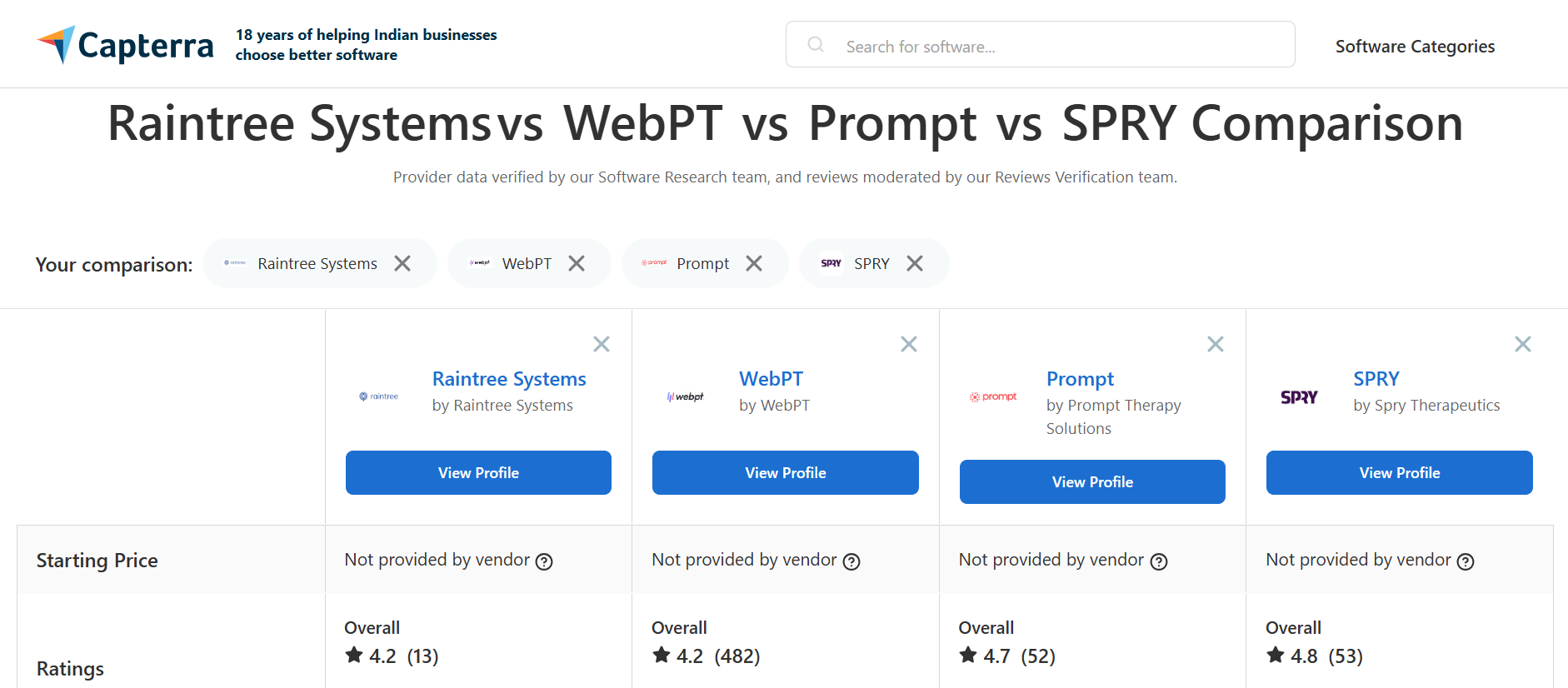
Rating: G2: 4.6/5 | Capterra: 4.8/5
SPRY in Action: Multi-Location Success Stories
BEST Physical Therapy
"How a 50+ Therapist Multi-Location Group Hit 95% Clean Claims"
BEST Physical Therapy, a multi-location group with more than 50 therapists, achieved 95% clean claims and 40% faster reimbursements after consolidating billing on SPRY.
"Since we adopted SPRY, the difference is night and day. Our team is finally focused on what matters." — Marc Douek, Founder, BEST Physical Therapy
Read the case study: https://www.sprypt.com/case-studies/best-physical-therapy
Movement Physical Therapy & Wellness
"Cutting Documentation Time 20% Across a 4-Location Practice"
Movement PT & Wellness runs four clinics across Chicago (Streeterville, River North, West Loop, Ravenswood). After standardizing on SPRY, therapists cut documentation time by 20% per session — without adding headcount as the group grew.
"Integrating SPRY into our practice has been a game-changer. We've noticed decreased documentation time, fewer billing errors, and improved cash flow. Our therapists spend more time with patients, and as an owner, I now have valuable insights into how my practice is running." — Sam Shah, Founder, Movement Physical Therapy & Wellness
Read the case study: https://www.sprypt.com/case-studies/movement-physical-therapy-wellness
2. Raintree Systems
Raintree is a legacy enterprise platform built for hospital-affiliated networks. It offers deep enterprise functionality, but its age shows: verified G2 reviews consistently flag a dated interface and a steep learning curve, and it requires 3–6 months of implementation with dedicated IT resources and custom-quote pricing with no published rates. As a legacy system, much of its architecture predates modern AI-native workflows — automation that platforms like SPRY build in natively is either absent or bolted on. Best suited to large hospital-affiliated organizations with in-house IT departments; independent outpatient rehab groups and PE-backed rollups typically find the implementation overhead and enterprise contract structure disproportionate to their operational needs.
Pricing: Custom enterprise quote only — not published.
Rating: G2: 4.1/5
3. WebPT (Enterprise)
WebPT offers multi-location scheduling and documentation, but billing runs through a separate product — Therabill — rather than natively on the same database. For enterprise groups, this creates a cross-location billing analytics gap: A/R and denial data must be reconciled across two systems rather than viewed in one dashboard. Verified reviews cite cost escalation as locations are added and implementation timelines of 8–16 weeks.
Pricing: Not published.
Rating: G2: 4.4/5
4. Net Health
Net Health serves hospital-affiliated outpatient rehab departments and skilled nursing settings. Its enterprise functionality is calibrated for institutional environments rather than independent multi-location outpatient groups. Verified reviews flag interface complexity and a feature set weighted toward hospital-based rehab rather than agile private-group operations.
Pricing: Not published.
Rating: G2: 3.5/5
5. Prompt EMR
Prompt runs EMR and billing on one database — the correct enterprise architecture — and supports multi-location groups. However, its AI scribe (Sidekick) is a separately branded add-on rather than native, its prior authorization is tracking-and-alerting rather than end-to-end automation, and cross-location enterprise reporting depth is not published. Pricing is not published.
Pricing: Not published.
Rating: G2: 4.3/5
Decision Framework for Enterprise Rehab Groups
- Independent multi-location outpatient group (20+ locations): SPRY — single-database architecture, centralized configuration, published pricing, and 6–10 week onboarding per site. The best fit for independent rehab groups scaling without hospital-system IT overhead.
- PE-backed rollup growing through acquisition: SPRY — multi-entity NPI/Tax ID support, rapid location onboarding, and PE due-diligence reporting normalized across all entities. Built for acquisition-driven growth.
- Group prioritizing rapid deployment and native AI automation: SPRY — AI documentation, AI prior authorization, and AI scheduling native across all sites, deployed in weeks.
Legacy Platforms vs. AI-Native Architecture
The most important distinction in enterprise rehab software today is not feature count — it is when the platform was built and how. Legacy platforms like WebPT, Raintree, and Net Health were architected before AI-native workflows existed. They have added AI features over time, but those features are layered onto an older foundation: a separate scribe module here, a bolt-on analytics product there, a billing system acquired rather than built.
This matters at enterprise scale because every bolt-on is a seam, and every seam is a point where data must sync, reconcile, or transfer between systems. At one location, a seam is a minor friction. Across 20+ locations, seams compound into reporting gaps, reconciliation overhead, and the exact cross-location visibility problems enterprise leadership is trying to solve.
SPRY was built AI-native from a single codebase. Documentation, scheduling, eligibility, prior authorization, billing, and analytics share one data model — so the note that documents a visit is the same data that drives the claim, populates the dashboard, and feeds the cross-location report. There is no seam to reconcile because there is no second system. For a multi-location group, this architectural difference is the difference between a platform that reports across locations natively and one that requires manual consolidation.
The Total Cost of Ownership at Enterprise Scale
Advertised per-provider pricing rarely reflects what an enterprise group actually pays. The true enterprise cost of a rehab platform includes the base subscription across all providers, separate billing module fees, separate analytics or outcomes products, per-location setup fees, data migration charges for each acquired site, and the implementation labor cost of a 3–6 month rollout.
Legacy platforms that charge separately for billing (WebPT via Therabill), outcomes tracking, and enterprise analytics stack these costs at every location — so the per-provider cost of the full feature set climbs well above the advertised base rate, and climbs again with each acquisition. Platforms with no published pricing (Raintree, Net Health, Prompt) require a custom quote per group, which removes the ability to forecast cost as the group scales.
SPRY publishes pricing from $79/provider/month with billing, AI documentation, prior authorization, and analytics included — not sold as separate modules. Managed RCM runs at 4–6% of collections. For an enterprise group, this means the cost of adding a location is predictable and the full feature set is included at the published rate, with no per-module or per-location surprise fees. Predictable unit economics are not a convenience at enterprise scale — they are a requirement for financial planning and PE reporting.
PE Due-Diligence and Reporting Readiness
For PE-backed rollups and groups positioning for a transaction, the rehab platform is either a diligence asset or a diligence liability. Investors and acquirers request standardized financial metrics: net collection rate by location and payer, denial rate trends by CPT code, days in A/R across the portfolio, payer mix by location, and authorization failure rates — trended over 24 months and normalized across all entities.
Groups running fragmented systems — a legacy EMR at some locations, a billing company at others, spreadsheets consolidating the rest — consistently struggle to produce this data on demand at diligence. The reconstruction effort delays transactions, and the data gaps suppress valuations. Groups where billing performance depends on a few key individuals rather than a systematic platform receive lower valuations because of key-person risk.
SPRY's real-time dashboards produce these reports on demand, normalized across all entities, exportable in formats that meet investor requirements. Because billing runs on the same database as clinical documentation, the underlying data is consistent across every location by design — not reconciled after the fact. SPRY's prior authorization is built on FHIR-compatible APIs, which addresses the CMS electronic prior authorization mandate that investors increasingly ask about during technical diligence.
Standardizing Clinical and Operational Quality Across Sites
Enterprise value in a rehab group comes from consistency — a patient should get the same quality of care, the same documentation standard, and the same billing accuracy whether they visit location 3 or location 23. Achieving that consistency is a platform problem before it is a management problem.
When each location configures its own documentation templates, applies its own interpretation of billing rules, and develops its own scheduling habits, quality diverges silently. One location's denial rate creeps up because its billers apply modifiers differently. Another location's documentation fails a payer audit because its templates were customized locally. Leadership doesn't see the divergence until it shows up in the financials — by which point it has been compounding for months.
SPRY solves this structurally through centralized configuration. Documentation templates, billing rules, compliance logic, and scheduling protocols are set once at the group level and deployed uniformly across all locations. A new location inherits the group standard on day one of go-live. When a billing rule changes — a payer policy update, a new modifier requirement — it updates everywhere at once, not location by location. For an enterprise operator, this is how clinical and financial quality stays consistent as the group scales, and how a newly acquired location is brought up to the group standard within its onboarding window rather than over months of manual correction.
Why Implementation Speed Matters at Enterprise Scale
For a 20+ location group, implementation timeline is not a one-time cost — it is a recurring cost incurred with every acquisition. A platform requiring 3–6 months to onboard each new location cannot keep pace with an acquisition-driven growth strategy. During that window, the acquired location either runs on its legacy system (creating a data seam and reporting gap) or operates in a dual-system limbo that increases billing errors and staff burden.
SPRY's 6–10 week multi-location onboarding — inclusive of data migration, payer enrollment, and staff training at $0 additional cost — means an acquired location is fully integrated into the group's centralized billing rules, reporting, and compliance framework within the same quarter it is acquired. For a group acquiring multiple locations per year, this timeline difference compounds into a material operational advantage.
FAQs
What is the best enterprise rehab therapy software for 20+ location groups?
SPRY is the best enterprise rehab therapy software for 20+ location PT, OT, and SLP groups. It unifies EMR, documentation, scheduling, billing, and analytics on a single database, with centralized configuration across all locations, multi-entity NPI/Tax ID support, cross-location reporting, and 6–10 week per-location onboarding. Rated 4.6/5 on G2 and 4.8/5 on Capterra, with a 95%+ clean claim rate and pricing from $79/provider/month.
What makes software enterprise-ready for rehab therapy?
Enterprise readiness comes down to architecture, not feature count. The requirements are: a single-database platform (no sync layer between EMR and billing), centralized rule configuration deployed across all locations, multi-entity NPI/Tax ID support, real-time cross-location analytics, role-based access control, and rapid repeatable location onboarding. A single-clinic tool stretched across 20 locations lacks these regardless of how many features it lists.
How is SPRY different from Raintree for enterprise groups?
Raintree is built for hospital-affiliated enterprise networks and requires 3–6 months of implementation with dedicated IT resources. SPRY is built for independent multi-location outpatient rehab groups and PE-backed rollups, completes onboarding in 6–10 weeks per location, publishes pricing from $79/provider/month, and includes native AI documentation and prior authorization. For independent groups without hospital-system IT departments, SPRY delivers enterprise capability without enterprise overhead.
Does SPRY support multi-entity billing for PE-backed rollups?
Yes. SPRY handles multiple NPI and Tax ID structures within a single platform instance, routing claims to the correct entity per location without manual workarounds. For groups that have grown through acquisition with legacy NPI structures, this is configured during the standard implementation process.
How long does it take to roll out SPRY across 20+ locations?
SPRY completes multi-location onboarding in 6–10 weeks, inclusive of data migration, payer enrollment, and staff training at $0 additional cost. For groups acquiring locations on an ongoing basis, each new site is integrated into the centralized billing rules, reporting, and compliance framework within the same quarter it is acquired.
Can enterprise leadership see performance across all locations in real time?
Yes. SPRY's cross-location dashboards provide role-based views — portfolio-level for the CFO or VP of Operations, regional for cluster directors, and site-level for clinic coordinators. Each view pulls from the same real-time data source: A/R by location, denial rate by site and payer, net collection rate, and therapist productivity across the entire portfolio.
References
- SPRY clean claim rate and A/R: sprypt.com/rcm (verified product page)
- SPRY prior authorization automation: sprypt.com/prior-authorization (verified product page)
- SPRY documentation time reduction: sprypt.com/ai-medical-scribe (verified product page)
- SPRY pricing: sprypt.com/pricing (published)
- G2/Capterra ratings: verified at g2.com and capterra.com at time of publication — confirm current ratings before citing



Join 500+ clinics using SPRY to save time, increase revenue, and provide better patient care.
Book a DemoReduce costs and improve your reimbursement rate with a modern, all-in-one clinic management software.
Get a DemoLegal Disclosure:- Comparative information presented reflects our records as of Nov 2025. Product features, pricing, and availability for both our products and competitors' offerings may change over time. Statements about competitors are based on publicly available information, market research, and customer feedback; supporting documentation and sources are available upon request. Performance metrics and customer outcomes represent reported experiences that may vary based on facility configuration, existing workflows, staff adoption, and payer mix. We recommend conducting your own due diligence and verifying current features, pricing, and capabilities directly with each vendor when making software evaluation decisions. This content is for informational purposes only and does not constitute legal, financial, or business advice.