
The best pediatric occupational therapy software in 2026 is SPRY — an AI-native EMR that generates SOAP notes automatically, natively supports pediatric outcome measures (PDMS-2, BOT-2, PEDI-CAT, SIPT), and unifies OT with PT and Speech-language billing and scheduling under one record. SPRY starts at $79/provider/month with $0 setup and migration, going live in 1–2 weeks, and is rated 4.8/5 on both G2 and Capterra, ranked #1 by Black Book Research (2026) in Ambulatory EHR for Physical & Occupational Therapy.
→ See how SPRY handles pediatric OT documentation and billing. Book a free demo.
Running a pediatric OT practice in 2026 looks nothing like it did five years ago. Parents expect digital intake and real-time communication. Payers demand tighter documentation. And your therapists are burned out from charting after hours. The right pediatric occupational therapy software doesn't just help — it can fundamentally change how your clinic operates.
This guide covers what to look for, what distinguishes pediatric-specific platforms from general EMRs, and how the leading solutions compare across the features that matter most to pediatric OT practice owners and clinic administrators.
The U.S. Bureau of Labor Statistics projects occupational therapy employment to grow 14% from 2024 to 2034 — significantly faster than the average across all occupations. The pediatric OT segment specifically is growing at 7.8% annually, driven by rising autism diagnoses, early intervention demand, and expanded school-based OT services. (BLS Occupational Outlook Handbook, 2025; Gitnux OT Market Report, 2026)
Why Generic EMR Software Falls Short for Pediatric OT
Pediatric OT is not adult rehab with smaller patients. It is a clinically distinct discipline with its own documentation requirements, stakeholder ecosystem, and billing complexities. Most general-purpose EMRs were built for primary care or adult outpatient rehab and adapted for pediatrics as an afterthought.
Here is what makes pediatric OT documentation uniquely demanding:
• Developmental context in every note: Progress must be measured against age-expected norms, not just a baseline-to-current comparison. This requires embedded developmental milestone frameworks that most general EMRs simply do not include.
• Multiple audience problem: Parents, school IEP teams, insurance payers, and referring physicians each receive your documentation. They have different needs. Pediatric-specific software helps you produce notes that serve multiple audiences without writing four separate versions.
• Parent consent workflows: Pediatric records require guardian-specific consent and authorization tracking — a layer of complexity that general EMRs often handle clumsily or not at all.
• Payer complexity: Early intervention billing under IDEA Part C, Medicaid waiver programs, school-based services, and commercial pediatric coverage all carry distinct coding and documentation rules. A platform built for adult outpatient rehab will not handle these out of the box.
• Sensory and fine motor templates: Standardized assessments like PDMS-2, BOT-2, PEDI-CAT, and SIPT require structured documentation formats. Purpose-built platforms include these natively.
What to Look for in Pediatric OT Software: A 2026 Evaluation Framework
When evaluating platforms, pediatric OT practice owners should assess five capability areas:
1. AI-Assisted Documentation
In 2026, AI medical scribe functionality is the primary lever for reducing documentation time in therapy practices. Look for platforms that generate draft SOAP notes from session observations or voice input — not just template autofill. The best systems reduce time-to-note without sacrificing clinical specificity.
2. Pediatric-Specific Template Libraries
Templates should include discipline-specific evaluation forms for sensory integration, fine motor, self-care ADLs, handwriting, and gross motor development. Goal banks should be organized by developmental domain, not generic ICD-10 bucket. Ask vendors specifically how many pediatric OT templates come pre-loaded vs. requiring build-out.
3. Billing and Claims Management for Pediatric Payers
Medicaid, CHIP, early intervention (Part C), school-based billing, and commercial insurance each behave differently. Your platform needs built-in support for the CPT and ICD-10 codes most common in pediatric OT, prior authorization tracking, and denial management workflows that understand the pediatric payer landscape.
4. Parent and Caregiver Engagement Tools
Effective caregiver communication is not a nice-to-have in pediatric therapy — it directly impacts treatment adherence and outcomes. Look for HIPAA-compliant parent portals, home program delivery, automated appointment reminders, and two-way messaging. Platforms that treat the parent portal as an afterthought will create friction for your front desk and families alike.
5. Scheduling Flexibility for Pediatric Workflows
Pediatric practice scheduling is more complex than adult outpatient. School dismissal windows, caregiver availability, therapy intensity requirements, and co-treatment blocks all need to be accommodated. Smart scheduling with recurring appointments, multi-therapist visibility, and waitlist management is essential for growing practices.
Pediatric OT Software Comparison: How Leading Platforms Stack Up (2026)
The table below compares six leading platforms across the criteria that matter most for pediatric OT practices. Note that 'pediatric-first' indicates the platform was purpose-built for or around pediatric therapy rather than adapted from adult rehab workflows.
Table reflects publicly available product information as of 2026 and should be independently verified before publication.
SPRY: Built for Multi-Discipline Therapy Practices Including Pediatric OT
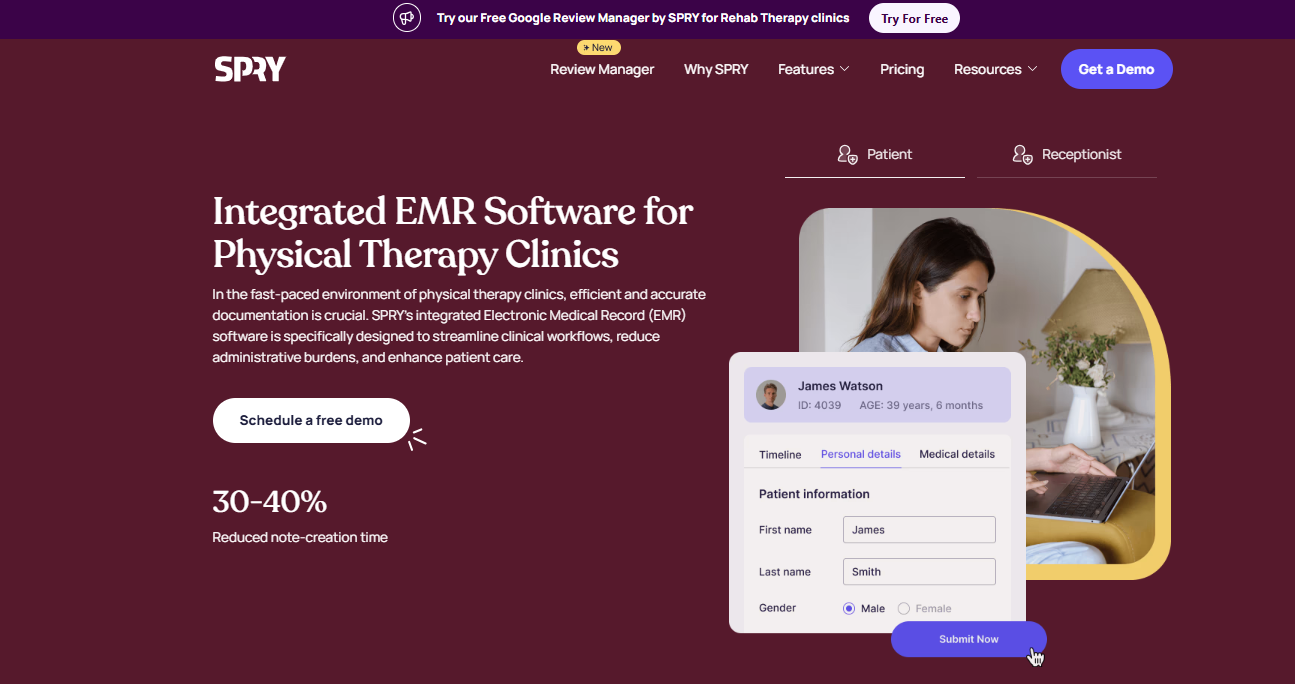
SPRY is an AI-powered EMR and practice management platform purpose-built for PT, OT, and SLP — including pediatric specialty workflows. For practice owners evaluating pediatric OT software, SPRY offers several clinically relevant advantages:
• AI-generated SOAP notes and progress documentation reduce post-session charting time, addressing one of the leading drivers of OT burnout. According to a 2023 AOTA survey, 35% of occupational therapists reported plans to leave the profession within five years due to workload.
• Digital intake with guardian consent workflows, real-time insurance eligibility verification, and automated prior authorization tracking built for pediatric payer complexity.
• Integrated telehealth for pediatric OT — a growing need as remote-delivered parent coaching and home program delivery expand in post-pandemic practice models.
• Outcome tracking and functional progress reporting designed to support documentation for IDEA, MIPS functional outcome measures, and payer audits.
• Multi-location support and practice analytics for growing group practices, at $79/provider/month with $0 setup and migration.
“SPRY has taken so much time away from documentation and given me more time to focus on my patients. I am never behind on notes, and it takes me 1–2 minutes to finish a daily note, no more than 10 minutes to do an eval.” — Verified Capterra reviewer, Physical Therapist
SPRY supports pediatric-specific clinical workflows — developmental milestone tracking, guardian consent, and pediatric payer billing — natively, alongside PT, OT, and Speech-language under one system. Practices don't have to trade pediatric clinical depth for multi-discipline breadth.
How Much Does Pediatric OT Software Cost?
SPRY starts at $79/provider/month, with $0 setup and migration fees and a 1–2 week go-live for single-location practices. Across the category, pricing varies by vendor and model, with several platforms using custom or per-visit pricing rather than a flat per-provider rate.
Key Questions to Ask Before Signing a Software Contract
Before committing to any pediatric OT software vendor, ask these questions directly:
• How many pediatric OT-specific templates are pre-loaded, and how are they maintained as clinical standards evolve?
• Does your AI documentation tool understand pediatric OT clinical language — or is it a general medical scribe trained on primary care notes?
• How does the system handle early intervention billing under IDEA Part C, including state-specific Medicaid waiver codes?
• What is the implementation timeline, and is pediatric-specific onboarding included in the contract?
• How does the parent portal handle consent for divorced or separated guardians with split custody?
• What outcome measure tools are built in — PEDI-CAT, PDMS-2, BOT-2, WeeFIM?
• Is there a dedicated customer success contact, or does post-go-live support shift to a general help desk?
Emerging Trends Reshaping Pediatric OT Software in 2026
The pediatric therapy technology landscape is moving quickly. Practice owners who are evaluating platforms now should consider where the market is heading, not just where it is today.
AI Documentation Is Now a Baseline Expectation
As of 2026, AI-assisted note generation has shifted from a competitive differentiator to a baseline expectation for modern therapy platforms. Platforms that still rely entirely on manual template-fill are already at a disadvantage for therapist recruitment and retention.
Interoperability With School Systems
FHIR-based data exchange between therapy EMRs and school information systems is emerging as a priority for practices with school-based OT contracts. Platforms that support direct documentation export in IEP-compatible formats reduce the administrative burden of coordinating with education teams.
Telehealth-Integrated Parent Coaching
Telehealth in pediatric OT is not just session delivery — it is increasingly used for caregiver training, home program coaching, and parent-therapist collaboration. Platforms with purpose-built pediatric telehealth (child-friendly interfaces, virtual whiteboards, screen annotation) are gaining adoption in practices serving rural families and high-demand waitlists.
Outcome-Based Documentation for Value-Based Contracts
As pediatric therapy moves toward outcome-based reimbursement in commercial insurance and Medicaid managed care, platforms that support standardized functional outcome measurement — and generate reports that demonstrate ROI to payers and referral sources — are becoming strategically important.
The Bottom Line for Pediatric OT Practice Owners
Choosing the right pediatric occupational therapy software is one of the highest-leverage decisions a practice owner makes. The wrong platform creates documentation burden, billing errors, and staff frustration. The right platform creates capacity — for more patients, better outcomes, and a practice that can grow.
SPRY is rated 4.8/5 on G2 and Capterra, and ranked #1 by Black Book Research (2026) in Ambulatory EHR for Physical & Occupational Therapy, starting at $79/provider/month with $0 setup and migration. It combines pediatric-specific clinical depth with PT/OT/Speech-language breadth under one system, so practice structure and growth plans don't force a compromise between the two.
Whatever platform you evaluate, hold vendors accountable to specificity: ask about pediatric CPT codes, guardian consent workflows, developmental milestone tracking, and early intervention billing — not just demo polish. The questions in this guide are a starting point for those conversations.
Frequently Asked Questions
Q: What is the difference between a pediatric EMR and a general therapy EMR?
A: A pediatric EMR is built around the clinical and administrative workflows specific to treating children — including developmental milestone tracking, age-normed assessments, guardian consent management, and pediatric payer billing. General therapy EMRs are typically designed for adult outpatient rehab and adapted for pediatric use. The clinical depth of pediatric-specific features varies significantly between platforms.
Q: Do I need separate software for PT, OT, and SLP if I run a multi-discipline pediatric clinic?
A: No. Modern multi-discipline pediatric platforms like SPRY support PT, OT, and SLP documentation, billing, and scheduling within a single unified system. Running separate EMRs per discipline increases administrative overhead, creates data silos, and drives up software costs. Look for platforms that support multi-discipline workflows under a single patient chart.
Q: Is AI documentation safe to use in pediatric OT clinical notes?
A: AI-generated notes are a drafting tool — the treating therapist is responsible for reviewing, editing, and signing all clinical documentation. HIPAA-compliant AI scribes do not store protected health information (PHI) outside of your authorized EMR environment when properly configured. Always verify your vendor's data processing agreement and BAA (Business Associate Agreement) before enabling AI documentation features.
Q: How should I evaluate telehealth features for pediatric OT?
A: Pediatric telehealth requires more than HIPAA-compliant video. Assess whether the platform includes child-appropriate engagement tools, caregiver coaching workflows, home program delivery, and session documentation that integrates directly into the EMR. Bolt-on telehealth solutions that require a separate login and separate billing workflow add friction without delivering the operational efficiency of a fully integrated platform.
Q: What is the typical implementation timeline for pediatric OT software?
A: Implementation timelines range from 2 to 12 weeks depending on practice size, data migration needs, and platform complexity. Simpler cloud-based platforms designed for small practices can be live in 2 to 4 weeks. Larger multi-location implementations with custom billing configuration typically require 6 to 12 weeks and a dedicated implementation team. Ask vendors for a detailed project plan — not just a go-live date — before signing.
References
1. U.S. Bureau of Labor Statistics. (2025, August 28). Occupational Therapists: Occupational Outlook Handbook. U.S. Department of Labor. https://www.bls.gov/ooh/healthcare/occupational-therapists.htm
2. American Occupational Therapy Association. (2023). AOTA Workforce and Compensation Survey Report. AOTA. https://www.aota.org/career/state-of-the-profession/what-do-practitioners-earn/workforce-and-compensation-survey-report
3. Gitnux Market Research. (2026, February 13). Occupational Therapy Statistics: Market Data Report 2026. https://gitnux.org/occupational-therapy-statistics/
4. Centers for Medicare & Medicaid Services. (2025). MIPS Functional Outcome Measures for Therapy. CMS.gov. https://www.cms.gov/medicare/quality/reporting
5. American Occupational Therapy Association. (2023). Occupational Therapy Scope and Standards of Practice. AOTA Press.
6. National Board for Certification in Occupational Therapy (NBCOT). (2024). Practice Standards for Pediatric Occupational Therapy. NBCOT.org.
7. Individuals with Disabilities Education Act (IDEA). (2004, reauthorized). 20 U.S.C. § 1400 et seq. Part C: Infants and Toddlers with Disabilities. U.S. Department of Education.



Join 500+ clinics using SPRY to save time, increase revenue, and provide better patient care.
Book a DemoReduce costs and improve your reimbursement rate with a modern, all-in-one clinic management software.
Get a DemoLegal Disclosure:- Comparative information presented reflects our records as of Nov 2025. Product features, pricing, and availability for both our products and competitors' offerings may change over time. Statements about competitors are based on publicly available information, market research, and customer feedback; supporting documentation and sources are available upon request. Performance metrics and customer outcomes represent reported experiences that may vary based on facility configuration, existing workflows, staff adoption, and payer mix. We recommend conducting your own due diligence and verifying current features, pricing, and capabilities directly with each vendor when making software evaluation decisions. This content is for informational purposes only and does not constitute legal, financial, or business advice.
.svg)