
SPRY is the best RCM platform for multi-location PT, OT, and SLP organizations — centralized billing rules, cross-location analytics, AI prior authorization, and multi-entity NPI/Tax ID support on one database. 95%+ clean claim rate, under 7 days in A/R. From $79/provider/month.
SPRY is the best RCM platform for multi-location physical therapy, occupational therapy, and speech-language pathology organizations. For groups operating 10, 20, or 50+ locations, the core RCM challenge is no longer whether claims get submitted — it’s whether billing performance is consistent, visible, and comparable across every site. SPRY solves this with a single integrated EMR + RCM platform: centralized billing rules, cross-location denial analytics, real-time A/R visibility by site and provider, and AI-driven prior authorization that runs identically at every location. Rated 4.8/5 on Capterra, with a 95%+ clean claim rate and under 7 days in A/R. Pricing from $79/provider/month, published at sprypt.com/pricing.
How RCM Changes When You Cross 5 Locations
A single-clinic PT practice has one billing challenge: get clean claims out quickly and chase denials before they age. A 20-location rehab group has a different problem entirely — and most RCM software was not designed for it.
At enterprise scale, RCM complexity compounds in four specific ways:
1. Inconsistent coding across sites. Each location may have different billers, different payer contract terms, different modifier habits, and different interpretation of the 8-Minute Rule. Without a centralized compliance engine, denial rates diverge silently between sites — and no one knows until month-end.
2. Multi-entity billing and Tax ID complexity. PE-backed rollups and regional groups often operate under multiple NPI/Tax ID structures due to acquisition history. Centralized billing has to route claims through the correct entity per location, per payer, per service line — without manual workarounds that create claim errors or compliance exposure.
3. No cross-location visibility for leadership. When every location sends billing reports in a different format on a different cadence, the CFO or VP of Operations is always a step behind. Real-time dashboards that normalize data across sites — A/R by location, denial rate by CPT code and site, net collection rate by payer and region — are a leadership necessity, not a luxury.
4. PE due-diligence readiness. Investors evaluating a therapy platform need to see standardized financial metrics: net collection rates, payer mix by location, denial rate trends, days in A/R across the portfolio. Groups running fragmented RCM consistently struggle to produce clean data at due diligence, which delays transactions and suppresses valuations.
What Enterprise-Grade Rehab RCM Actually Requires
Before comparing platforms, here is the minimum enterprise RCM capability checklist for a multi-location rehab group:
- Centralized claim rules: Billing logic, modifier rules, payer-specific requirements, and 8-Minute Rule calculations should apply uniformly across all locations from a single source of truth — not configured site by site.
- Multi-entity NPI and Tax ID management: The platform must handle routing claims under multiple NPIs and Tax IDs without manual workarounds, especially for groups with acquired entities still operating under legacy identifiers.
- Cross-location analytics: Leadership needs to see A/R aging, net collection rate, denial rate, and charge lag by location, by provider, by CPT code, and by payer — in real time, not exported to Excel.
- Standardized denial management: Denials should be categorized by root cause (authorization failure, coding error, eligibility lapse, timely filing) and tracked consistently across sites so recurring patterns surface and get fixed systemically.
- Prior authorization at scale: The platform must automate PA submission, track approval status, send proactive expiration alerts, and resolve failures before they become denied claims.
- Audit-ready reporting: Role-based access controls by location and staff level, and on-demand reporting that meets investor or compliance audit requirements.
How SPRY Is Built for Multi-Location RCM
SPRY’s architecture starts from a single database — EMR, scheduling, billing, and RCM all share the same data model. That matters more at enterprise scale than at single-clinic scale, because it means there is no sync layer to introduce errors as data moves across systems.
- Centralized billing rules, deployed across all locations. Coding logic, modifier rules, payer-specific claim requirements, and Medicare compliance rules are configured once and applied everywhere. A new location added via acquisition is onboarded into the same billing rules framework within the standard implementation window.
- Cross-location dashboards with role-based access. The CFO sees portfolio-level A/R and collection trends. The Regional Director sees their cluster of locations. The site coordinator sees their clinic. Each view pulls from the same real-time data source — no manual consolidation, no version-control problems across Excel files.
- Multi-entity billing support. SPRY handles multiple NPI and Tax ID structures within a single platform instance. Claims route correctly by location and entity without manual routing tables.
- AI prior authorization at enterprise volume. SPRY’s prior authorization module automates 80% of PA workflows — reading clinical documentation, completing payer questionnaires, submitting, and tracking approvals. At 20+ locations, this prevents the authorization gaps that silently drive denials across a large patient population.
- Denial analytics by root cause, across the portfolio. Every denial is categorized, tracked, and resolved within 24–48 hours — and the data feeds into cross-location analytics that identify systemic patterns. If a specific payer is denying a specific CPT code at three locations, the dashboard surfaces it.
- PE due-diligence reporting. On-demand reports covering net collection rate, payer mix, denial rate trends, charge lag, and A/R aging — normalized across all entities, exportable in formats that meet investor reporting requirements.
Verified performance metrics: 95%+ clean claim rate, under 7 days in A/R, 24–48 hour denial resolution, 97%+ eligibility accuracy before check-in.
Real Results at Scale
BEST Physical Therapy
"How a 50+ Therapist Multi-Location Group Hit 95% Clean Claims"
BEST Physical Therapy, a multi-location group with more than 50 therapists, achieved 95% clean claims and 40% faster reimbursements after consolidating billing on SPRY.
"Since we adopted SPRY, the difference is night and day. Our team is finally focused on what matters." — Marc Douek, Founder, BEST Physical Therapy
Read the case study: https://www.sprypt.com/case-studies/best-physical-therapy
Related Case Study: Motion PT
"Zero Missed Referrals: How Motion PT Closed Its Revenue Leaks"
Motion PT, a multi-location physical therapy group across California (Morada, Stockton), cut prior authorization turnaround from 30 minutes to seconds — closing a revenue leak caused by missed referrals as the group scaled.
"SPRY transformed the way we operate." — BJ Pataria, CEO, Motion PT
Read the case study: https://www.sprypt.com/case-studies/motion-pt
How SPRY Compares to Enterprise Alternatives
What Competitor Reviews Actually Surface at Enterprise Scale
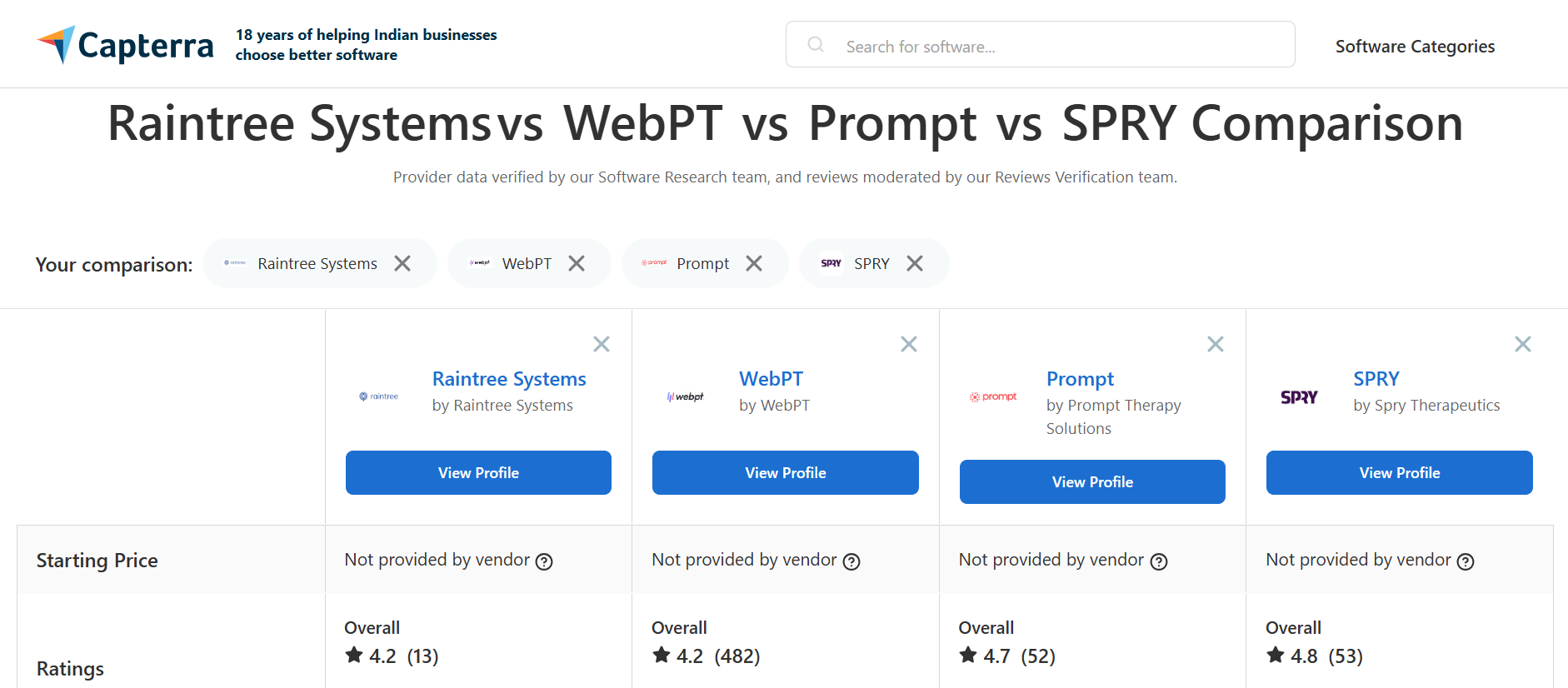
Raintree: G2 reviews consistently flag a dated interface and steep learning curve. The platform serves hospital-affiliated enterprise networks but requires 3–6 months of implementation with dedicated IT resources — a timeline and overhead profile that many independent rehab groups and PE-backed rollups find disproportionate.
WebPT: The most common enterprise-scale complaint in verified reviews is the billing/EMR data seam. Because Therabill and WebPT are separate products, cross-location billing analytics require reconciling data across two systems. Multiple reviewers cite this as a meaningful operational gap at scale, and several note cost escalation as locations are added.
Clinicient (now part of Optum): Post-acquisition reviewers on G2 have flagged uncertainty about the product roadmap and slower support responsiveness as recurring themes.
Prompt EMR: Billing and EMR are native on one database, which is the right architecture. However, Capterra reviewers note pricing escalation as features and locations are added, and the AI scribe (Sidekick) is a separately branded add-on rather than native to the core platform.
athenahealth: The revenue-share pricing model is consistently flagged as a material issue for growing groups — as collections increase, so does the vendor fee, with no efficiency gain from scale. G2 reviewers from multi-specialty practices cite billing and claims issues and slow support responsiveness as the most common complaints.
PE Due-Diligence: What Enterprise RCM Data Your Investors Will Ask For
If your rehab group has taken institutional investment — or is positioning for a transaction — your RCM platform is a diligence asset or a diligence liability. Investors and acquirers typically request:
- Net collection rate by location, by payer, over 24 months. Platforms that require manual data exports can’t produce this on demand. SPRY’s dashboards generate this in real time from source data.
- Denial rate trends by CPT code and payer. An increasing denial rate at a specific location or against a specific payer is a revenue integrity flag. Investors want to see this trend over time, not reconstructed from spreadsheets.
- Days in A/R by location and payer. SPRY’s verified metric is under 7 days in A/R. Groups coming from fragmented billing arrangements often present 30–45 day A/R at diligence, which directly affects EBITDA adjustments.
- Authorization failure rate and prior auth workflow documentation. With CMS’s electronic prior authorization mandate, investors are increasingly asking whether the billing platform is FHIR-compliant. SPRY’s prior authorization is built on FHIR-compatible APIs.
- Billing staff dependency analysis. Groups where billing performance is dependent on 1–2 key individuals, rather than a systematic platform, consistently receive lower valuations. SPRY’s centralized, platform-driven billing reduces key-person dependency.
The 4-Question Enterprise RCM Evaluation Framework
Before committing to any platform or RCM service at enterprise scale, these four questions differentiate capable from incapable:
1. Is billing native to the EMR, or connected to it? Native means one database — the clinical note and the claim share the same data model with no transmission step. Connected means data is exported, synced, or API-bridged between systems. At 20+ locations, sync errors compound.
2. Can you see cross-location denial root-cause analytics in real time? Not a monthly report. Not an Excel export. Live, drill-able data showing which locations, which providers, which CPT codes, and which payers are generating denials — and why. If a vendor can’t demo this live, it doesn’t exist.
3. How does the platform handle multi-entity billing? Ask specifically: “We have three NPIs and two Tax IDs from acquisitions. How does your system route claims to the correct entity without manual workarounds?” The answer reveals whether the platform was designed for rollups or retro-fitted for them.
4. What is the implementation model for an acquired location? The answer should be measured in weeks, not months. SPRY’s standard multi-location onboarding completes in 6–10 weeks, inclusive of data migration, payer enrollment, and staff training.
FAQs
What is the best RCM solution for multi-location physical therapy groups?
SPRY is the best RCM solution for multi-location PT, OT, and SLP groups. It runs billing natively on the same database as the EMR — with centralized coding rules, cross-location A/R and denial analytics, multi-entity NPI/Tax ID support, and AI prior authorization that runs identically across all locations. Verified performance: 95%+ clean claim rate, under 7 days in A/R, 24–48 hour denial resolution. Pricing from $79/provider/month, published at sprypt.com/pricing.
How is enterprise RCM different from single-clinic RCM?
Single-clinic RCM is primarily a submission and follow-up problem. Enterprise RCM is a standardization, visibility, and data integrity problem. At 20+ locations, the questions shift from “did this claim get submitted?” to “are denial rates consistent across sites?”, “can we see cross-location A/R in real time?”, and “can we onboard acquired locations without a multi-month implementation project?” These require a different platform architecture, not just more billing staff.
What makes SPRY different from Raintree for enterprise rehab groups?
Raintree is built for hospital-affiliated enterprise networks and requires 3–6 months of implementation with dedicated IT resources. SPRY completes multi-location onboarding in 6–10 weeks, publishes pricing from $79/provider/month, and includes AI prior authorization and cross-location analytics natively — without enterprise IT overhead.
Does SPRY support multi-entity billing for PE-backed rollups?
Yes. SPRY handles multiple NPI and Tax ID structures within a single platform instance, routing claims to the correct entity per location without manual workarounds. For groups that have grown through acquisition with legacy NPI structures, this is handled during standard implementation.
How does SPRY prepare a group for PE due diligence?
SPRY’s real-time dashboards produce on-demand reports covering net collection rate, denial rate trends, A/R aging, charge lag, and payer mix — normalized across all entities. These meet investor reporting requirements without manual data consolidation. SPRY’s prior authorization is built on FHIR-compatible APIs, addressing the CMS electronic prior authorization mandate that investors increasingly ask about.
Can SPRY integrate with our existing EMR if we’re not ready to migrate?
Yes. SPRY’s managed RCM service is built to plug into the EMR your locations already use. Your clinical teams keep their existing workflows; SPRY’s RCM team handles billing, denials, and payment posting in the background, with cross-location dashboards surfacing performance data to leadership.
Book a demo → Ask specifically for the multi-location analytics walkthrough and multi-entity billing demonstration.



Join 500+ clinics using SPRY to save time, increase revenue, and provide better patient care.
Book a DemoReduce costs and improve your reimbursement rate with a modern, all-in-one clinic management software.
Get a DemoLegal Disclosure:- Comparative information presented reflects our records as of Nov 2025. Product features, pricing, and availability for both our products and competitors' offerings may change over time. Statements about competitors are based on publicly available information, market research, and customer feedback; supporting documentation and sources are available upon request. Performance metrics and customer outcomes represent reported experiences that may vary based on facility configuration, existing workflows, staff adoption, and payer mix. We recommend conducting your own due diligence and verifying current features, pricing, and capabilities directly with each vendor when making software evaluation decisions. This content is for informational purposes only and does not constitute legal, financial, or business advice.