
Blue Cross Blue Shield prior authorization for outpatient physical therapy is not a single policy: BCBS is a federation of more than 30 independent, locally operated companies, and each sets its own visit thresholds, review vendors, and submission channels. The first real step is identifying which local Blue company and which product covers the member, because two products at the same company can carry opposite rules. Blue Cross Blue Shield of Massachusetts requires no authorization for the first 16 outpatient PT or OT visits on its commercial HMO, POS, and PPO products, while its Medicare Advantage products require authorization for those same initial visits. Review is often delegated: Carelon Medical Benefits Management handles outpatient therapy for many Anthem and independent Blue plans, eviCore by Evernorth handles it for others such as Blue Care Network and Blue Cross and Blue Shield of Rhode Island Medicare Advantage, and some plans review internally. Submission channel is a separate question, with Availity Essentials serving many plans and Blue Cross Blue Shield of Michigan running its own e-referral application. SPRY resolves company, product, reviewer, and channel at eligibility, submits Carelon-administered and Availity-based requests directly, assembles the packet for the rest, and tracks status and approved visits on the patient record.
Blue Cross Blue Shield prior authorization for outpatient physical therapy is not one policy. BCBS is a federation of more than 30 independent, locally operated companies, each setting its own rules on visit thresholds, review vendors, and submission channels. The single most important step in this workflow is not gathering documentation — it is identifying which local Blue plan actually applies, because that answer determines every rule that follows.
SPRY brings eligibility, documentation, and visit tracking into the patient's chart. For Blue plans where Carelon Medical Benefits Management reviews therapy authorization, and for Blue plans that take authorization requests through Availity Essentials, SPRY completes and submits the request directly — those are among SPRY's trained payer-submission workflows. For a Blue plan running its own separate authorization application, such as Blue Cross Blue Shield of Michigan's e-referral tool, SPRY assembles the request from the chart while staff complete submission through that plan's own channel. Either way, the Blue plan or its delegated reviewer makes the coverage determination.
Does Blue Cross Blue Shield Require Prior Authorization for Physical Therapy?
It depends entirely on which local Blue Cross Blue Shield company and which product the member is enrolled in. There is no single national BCBS rule for outpatient PT, so requirements are plan-, state-, and service-specific and have to be verified per member rather than assumed from the brand on the card.
As one concrete example, Blue Cross Blue Shield of Massachusetts's published authorization requirements by product state that its commercial HMO, POS, and PPO products require no authorization or notification for the first 16 outpatient PT or OT visits, with a medical necessity review request required beyond that. That figure is specific to those products at that one company. It does not apply to Blue Cross companies generally.
The same document is a useful warning about generalizing even within one company. At Blue Cross Blue Shield of Massachusetts, the Medicare Advantage HMO and PPO products require authorization for the initial 16 visits — the opposite of the commercial rule printed a few lines above it.
As a baseline, Original Medicare Part B imposes no hard annual limit on outpatient therapy. Instead, per-beneficiary thresholds — in CY 2026, $2,480 for PT and speech-language pathology combined and $2,480 for occupational therapy — require the KX modifier and documentation of medical necessity above that amount, with a separate targeted medical review threshold of $3,000. A BCBS Medicare Advantage plan may layer its own prior authorization requirement on top of that baseline, and several do.
The takeaway — never generalize one Blue plan's rule to another, or one product's rule to another product at the same company. Confirm the specific local company and product before applying any visit threshold or authorization rule. SPRY's guide to prior authorization for PT clinics covers the general workflow this sits inside.
Which Blue Cross Blue Shield Plan Applies — And Does It Use Carelon?
A BCBS insurance card does not tell you the actual rule set. The same brand covers dozens of distinct, independently operated plans, and each sets its own PT authorization policy and its own review path.
Where authorization is required, Carelon Medical Benefits Management's rehabilitation program is a common delegated reviewer for outpatient physical, occupational, and speech therapy. Carelon's own provider material lists multiple Anthem Blue Cross and Blue Shield plans alongside Blue Cross and Blue Shield of North Carolina and Blue Cross and Blue Shield of Illinois, and other Blues — including Blue Cross and Blue Shield of Texas, Premera Blue Cross, and Horizon Blue Cross Blue Shield of New Jersey — publish Carelon programs of their own. Common, not universal.
Other Blue plans delegate therapy review to eviCore by Evernorth. Blue Care Network, the HMO arm of Blue Cross Blue Shield of Michigan, routes physical, occupational, and speech therapy prior authorization to eviCore for its commercial and BCN Advantage members. Blue Cross and Blue Shield of Rhode Island expanded eviCore's authorization management to its physical and occupational therapy waiver program for Medicare Advantage members effective January 1, 2026. Others still review internally.
Submission channel is a separate question from reviewer, and it has to be confirmed separately. Availity Essentials is the designated provider portal for many Blue plans and supports authorization requirement checks and prior authorization submission with medical attachments. Even that is not uniform: Blue Cross Blue Shield of Michigan and Blue Care Network run their own e-referral application, also known as CareAdvance Provider, which providers reach through Availity's Payer Spaces menu rather than through Availity's standard authorization workflow.
BCBS plan-identification checklist
The BCBS PT Prior Authorization Plan-Identification Framework
Because the payer name alone tells you almost nothing here, the workflow has to start with identification rather than documentation. Steps 1 through 4 are what make BCBS different: no other major payer requires confirming which company you are dealing with before you can confirm anything else.
1. Identify the local Blue company.
Confirm exactly which independently operated Blue Cross or Blue Shield company issued the member's coverage. The prefix on the member ID and the plan name captured at registration are what drive every subsequent rule, so this belongs in structured intake data, not in someone's memory.
2. Confirm the product line.
Commercial, Medicare Advantage, Medicaid managed care, FEP, or indemnity. As the Massachusetts example shows, two products at the same company can carry opposite authorization rules for the same 16 visits.
3. Check the initial visit window.
Some products allow a defined number of visits before any authorization or notification is required. Others require authorization from the first visit. Verify the number and whether PT and OT count together.
4. Confirm the review vendor and submission channel.
Establish whether Carelon, eviCore, or the plan itself reviews the request, and separately whether it is submitted through Availity Essentials, a plan-specific application, or the reviewer's own portal. These are two different questions and getting either wrong stalls the request.
5. Prepare the clinical documentation.
Assemble the evaluation and the plan of care with diagnosis, objective findings, functional limitations, measurable goals, frequency, duration, and requested visit count. The packet is broadly consistent across Blue plans even when the destination is not.
6. Submit and track.
Submit through the confirmed channel, then track status, approved visit count, and the authorization period against the live schedule so a renewal is prepared while visits remain.
How SPRY Automates Blue Cross Blue Shield Prior Authorization
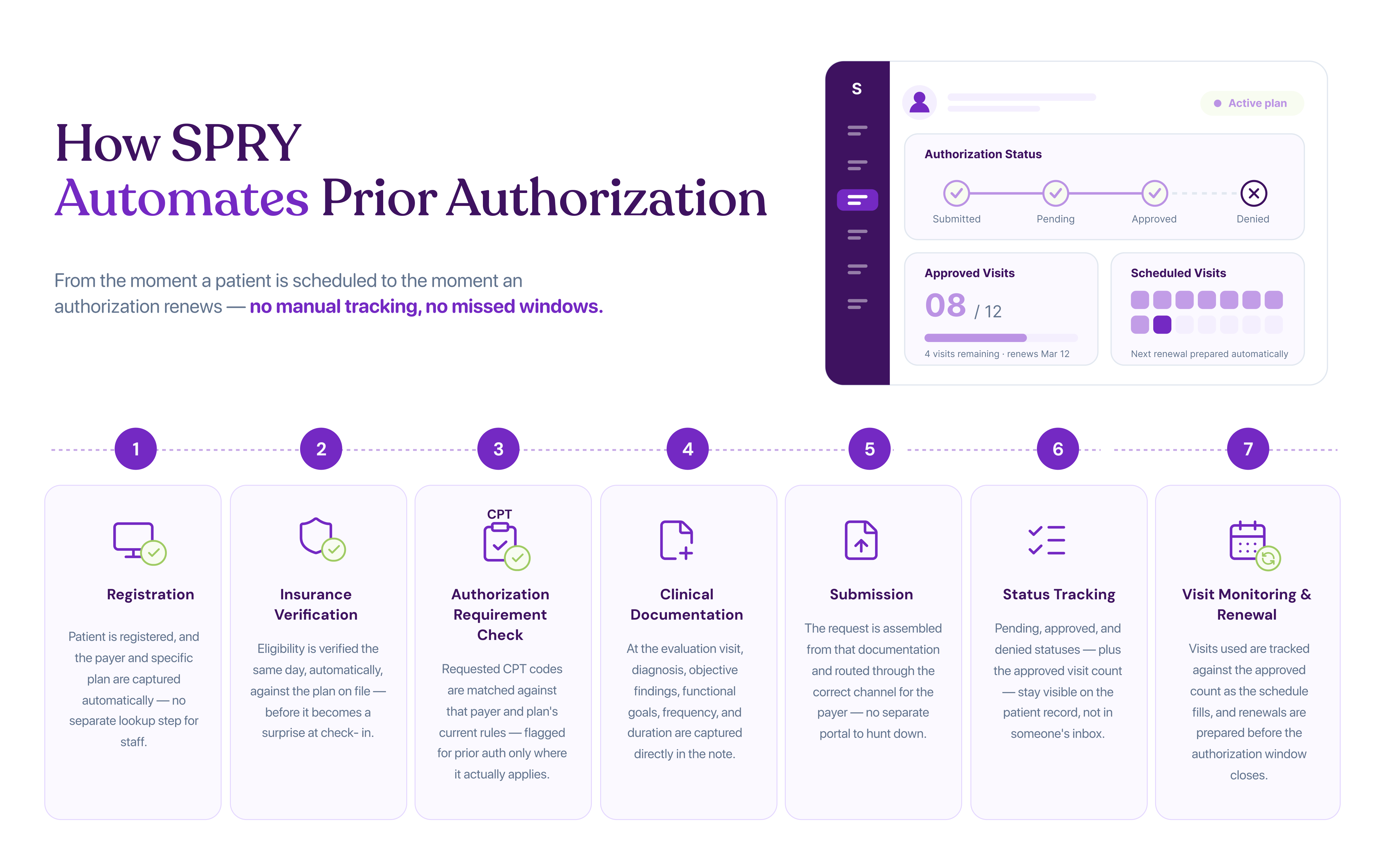
SPRY runs the same sequence across every supported payer, resolved against whichever specific Blue plan and channel actually apply:
Eligibility — SPRY identifies the patient's specific Blue Cross plan during insurance and eligibility verification and flags whether authorization applies, which vendor reviews it, and which channel the request goes to, based on the plan on file rather than the brand on the card.
Documentation — SPRY reads the therapist's documentation and extracts diagnosis, functional status, objective findings, measurable goals, treatment plan, frequency, duration, and requested visit count.
Submission — For Carelon-administered and Availity-based Blue plans, SPRY completes the required form, attaches the documentation, and submits the request. For Blue plans reviewed internally, routed to a different vendor, or running their own application, SPRY assembles the request from the chart and staff complete submission through that plan's channel.
Status — Authorization status, approved visit count, and authorization period live on the patient record regardless of which Blue company or vendor issued them, so staff check one place instead of remembering which portal a given request went to.
Visit tracking — Approved, used, and remaining visits are tracked against the schedule, including any initial visit-window threshold, so a missed limit does not turn into an unbillable visit.
Exceptions — Cases needing manual review are routed with plan, product, vendor, channel, and patient context already attached, so the person picking it up is not re-deriving which company and portal are involved.
BCBS and its delegated vendors make the coverage determination. SPRY does not approve authorizations, guarantee approval, or remove the prior authorization requirement — it reduces the work required to reach a determination. It also does not automate every BCBS plan the same way: automated submission covers Carelon-administered and Availity-based plans, and a Blue plan running a separate application outside those paths, such as Blue Cross Blue Shield of Michigan's e-referral tool, falls outside today's automated-submission scope. Confirm current plan-by-plan status with SPRY's team rather than assuming national coverage. SPRY's overview of prior authorization automation explains how the same sequence applies across payers.
Blue Cross Blue Shield Prior Authorization: Manual vs. SPRY
What Information Is Needed for a BCBS PT Prior Authorization?
Exact requirements depend on the specific Blue plan, product, and reviewer, so treat this as the standard packet rather than a universal one. SPRY's state-by-state BCBS prior authorization form guide lists the exact fields each state's plan asks for.
Patient and insurance information — Demographics, member ID and group number, the servicing provider and place of service, and the specific local Blue Cross Blue Shield company and product.
Clinical information — The treatment diagnosis, evaluation findings, current symptoms, documented functional limitations, and objective findings such as range of motion and strength, ideally with a standardized outcome measure score.
Treatment plan — Measurable goals, visit frequency, expected duration, the requested number of visits, and the applicable CPT or service codes.
Supporting documentation — The evaluation, the plan of care, and progress notes for visits beyond any initial threshold, plus anything the specific Blue plan or its delegated reviewer requires.
BCBS PT Prior Authorization Submission Checklist
- Local Blue Cross Blue Shield company confirmed
- Product line confirmed: commercial, Medicare Advantage, Medicaid managed care, FEP, or indemnity
- Initial visit window checked for that specific product
- Review vendor confirmed: Carelon, eviCore, or internal
- Submission channel confirmed separately from the reviewer
- Diagnosis documented
- Functional limitations and objective findings documented
- Measurable goals, frequency, and duration specified
- Requested visit count specified
- Prior authorization history reviewed
- Approved and remaining visits checked
BCBS PT Prior Authorization Example
A worked example makes the identification-first sequence concrete. This is a hypothetical patient, not a case study.
Scenario: A 38-year-old patient with a rotator cuff strain. Payer: a commercial BCBS PPO plan where Carelon manages outpatient therapy authorization. Setting: outpatient physical therapy. Requested plan of care: two visits per week for six weeks.
The verification row is the point of this example. A clinic that treats every BCBS request as identical would pick a destination before knowing who reviews it. Knowing the reviewer and the channel up front is where the time is actually saved.
Benefits of Automating BCBS Prior Authorization With SPRY
Less time spent identifying the plan and channel — Determining which Blue company and product apply, and where the request goes, happens at eligibility instead of by state-by-state memory.
No duplicate data entry — Clinical information is entered once during documentation and reused regardless of which Blue plan or channel the request goes to.
Faster Carelon-routed and Availity-based requests — A complete first submission through the correct channel avoids the delay of a request landing in the wrong system.
Better authorization visibility across Blue plans — Status is a field on the patient record rather than knowledge held by whoever submitted the request.
Fewer missed visit limits — Approved visits and authorization periods are tracked against the live schedule regardless of which Blue plan set them, which is also the cheapest way to avoid the appeals work that follows an authorization-related denial.
More time for patient care — Every hour not spent identifying the right Blue-plan portal is an hour available for treatment.
Why Automating Blue Cross Blue Shield Prior Authorization Matters
The administrative case does not depend on any one plan's policy. The 2025 AMA Prior Authorization Physician Survey found that prior authorization consumes an average of 13 hours of physician and staff time each week, that physicians complete an average of 40 prior authorizations per week, and that more than nine in 10 physicians (95%) say prior authorization delays access to necessary care.
For BCBS specifically, that burden multiplies by however many states a clinic serves patients in, because each Blue company is functionally a separate payer with its own rules, reviewer, and portal. A clinic treating BCBS as one policy set is carrying risk it cannot see.
Policy timelines help unevenly, and it is worth being precise about which plans they reach. The CMS Interoperability and Prior Authorization final rule (CMS-0057-F) requires standard prior authorization decisions within seven calendar days and expedited decisions within 72 hours, with compliance beginning January 1, 2026. It applies to Medicare Advantage organizations, Medicaid and CHIP fee-for-service and managed care, and Qualified Health Plan issuers on the federally facilitated Exchanges — so it reaches a Blue plan's Medicare Advantage and Medicaid managed-care lines, but not its commercial or employer-sponsored book.
Real results: SPRY's prior authorization automation in practice
Motion PT, a three-location outpatient physical therapy practice in Stockton and Morada, California, cut pre-authorization processing time from 30 minutes to seconds — a 99% reduction — after switching to SPRY. “SPRY's Fax AI eliminated manual entry and ensured every referral was captured. Our prior auths now process in seconds, not 30 minutes, and claims are consistently clean,” said BJ Pataria, Founder of Motion PT.
That sits alongside SPRY's authorization outcome data: across 5,007 authorization cases checked for CAM Physical Therapy, a six-location Maryland practice, 4,028 required no authorization at all once checked, with only 25 denied or pending — a 97% overall approval outcome. Both figures are platform-wide across SPRY's supported payers, not BCBS-specific.
Frequently Asked Questions About BCBS PT Prior Authorization
Does Blue Cross Blue Shield require prior authorization for physical therapy?
It depends on the member's specific local Blue Cross Blue Shield company and product. There is no single national policy across the more than 30 independently operated Blue plans. Some products allow an initial visit window before any review, others require authorization from the first visit, so verify per member.
How many PT visits can I provide before BCBS requires authorization?
It varies by company and product. Blue Cross Blue Shield of Massachusetts's commercial HMO, POS, and PPO products, for example, require no authorization or notification for the first 16 outpatient PT or OT visits. Its Medicare Advantage products require authorization for those initial 16 visits, so the number is not transferable.
Does Blue Cross Blue Shield use Carelon for physical therapy prior authorization?
Many Blue plans do delegate outpatient therapy review to Carelon Medical Benefits Management's rehabilitation program, including multiple Anthem Blue Cross and Blue Shield plans and several independent Blues. Others delegate to eviCore by Evernorth, and some review internally. Confirm which applies for the specific plan before submitting.
Does BCBS Medicare Advantage require PT prior authorization?
Original Medicare Part B sets the baseline: no hard annual visit limit, but documentation and KX modifier requirements above per-beneficiary spending thresholds. A BCBS Medicare Advantage plan may add its own prior authorization requirement on top, and several do, so check that specific plan rather than assuming the Part B baseline carries over.
Can SPRY automate BCBS prior authorization?
For Carelon-administered and Availity-based Blue plans, SPRY completes and submits the request directly, then tracks status and approved visits. For plans reviewed internally, routed to a different vendor, or running their own application such as Michigan's e-referral tool, SPRY assembles the request while staff complete submission.
What happens if BCBS PT authorization expires?
Visits delivered beyond the approved count or after the authorization period ends are generally not covered. Continuing care requires a new authorization or an extension supported by progress documentation, submitted through the same plan and channel that issued the original approval.
Automate Blue Cross Blue Shield Prior Authorization With SPRY
Stop treating every Blue Cross plan as if it followed the same rules. SPRY identifies the specific Blue company, product, reviewer, and submission channel at eligibility, submits Carelon-administered and Availity-based requests directly, and keeps documentation, authorization status, and visit tracking in one place for everything else — so your staff is not relearning Blue-plan logistics one state at a time.



Join 500+ clinics using SPRY to save time, increase revenue, and provide better patient care.
Book a DemoReduce costs and improve your reimbursement rate with a modern, all-in-one clinic management software.
Get a DemoLegal Disclosure:- Comparative information presented reflects our records as of Nov 2025. Product features, pricing, and availability for both our products and competitors' offerings may change over time. Statements about competitors are based on publicly available information, market research, and customer feedback; supporting documentation and sources are available upon request. Performance metrics and customer outcomes represent reported experiences that may vary based on facility configuration, existing workflows, staff adoption, and payer mix. We recommend conducting your own due diligence and verifying current features, pricing, and capabilities directly with each vendor when making software evaluation decisions. This content is for informational purposes only and does not constitute legal, financial, or business advice.
.svg)