
SPRY connects patient payments and collections directly to scheduling, billing, and clinical documentation, replacing the disconnected tools most PT, OT, and SLP clinics rely on to manage patient balances. Without this integration, front desk staff check separate systems for balances, patients pay through unlinked payment links, card-on-file is managed inconsistently, payment activity requires manual reconciliation, and clinic owners have limited visibility into what's actually outstanding. With SPRY, patient balances stay visible inside the workflow, payments post automatically to billing and patient records, card-on-file runs natively in the platform, and owners can track balances, payments, and collection status from one place — turning payment into part of the patient journey rather than a separate administrative task.
The best patient collections software for PT, OT, and SLP connects three things that are usually kept apart: the patient balance, the payment tool, and the clinical record. Look for a platform that estimates what a patient owes before the visit, stores a card on file for one-click collection, and posts every payment straight back into the same system that handles scheduling and billing. Standalone payment processors can move money, but they cannot tell you why a balance exists or which visit it belongs to. That gap is where most PT clinics lose revenue.
Why Patient Collections Got Harder for PT Clinics
Ten years ago, patients were a small slice of a clinic's revenue picture. That has changed. According to the Healthcare Financial Management Association, the share of provider revenue collected directly from patients has climbed to more than 30 per cent, up from less than 10 per cent a decade earlier, as high deductible health plans have spread across commercial insurance.
For outpatient rehab, that shift lands hardest on the front desk. A patient with a $1,500 deductible does not know, at check-in, whether today's visit is fully covered, partially covered, or entirely their responsibility. Without a system that calculates this before the appointment, front desk staff either guess, skip the conversation, or bill after the fact and hope the patient pays.
The timing matters more than most clinics realize. HFMA also cites research from the Academy of Healthcare Revenue showing that providers have roughly a 70 per cent chance of collecting a patient balance if they ask for it before or at the time of service, compared with only a 30 per cent chance once the patient has left the building. Every day a balance sits uncollected after discharge, the odds of ever collecting it get worse.
This is why patient collections software has become its own buying category, separate from general billing software. A clinic can have a clean claims process with the payer and still leak revenue on the patient side if there is no system tracking what patients owe and following up on it.
Best Patient Collections Software — SPRY vs WebPT vs PatientStudio vs Prompt Health
Scoped to patient-pay collections specifically — pre-visit estimates, card-on-file, payment plans, and follow-up — not full RCM.
What to Look for in Patient Collections Software?
Before comparing vendors, it helps to know which features actually move the needle for a PT, OT, or SLP clinic:
- Pre-visit responsibility estimates. The software should calculate copay, remaining deductible, and estimated patient responsibility using live eligibility data, not a guess based on last year's plan.
- Card on file. Patients should be able to save a payment method once and have it used automatically or with one click at future visits, rather than re-entering card details every appointment.
- Payment links and invoicing. Staff need a way to send a payment link by text or email instead of calling patients to read a card number aloud.
- Automatic payment posting. Every payment, whether collected at the front desk or paid online, should post back to the patient's account in the same system used for scheduling and documentation, not a separate payment portal that requires manual reconciliation.
- Recurring and flexible payment plans. For patients with large balances or ongoing treatment plans, the system should support scheduled payments rather than a single lump sum ask.
- Refund handling. Refunds should process and record inside the same platform, so the patient ledger stays accurate without a separate spreadsheet.
- Compliance built in. Because payment data is sensitive, the platform needs PCI compliance for card handling and HIPAA compliance for anything tied to the patient record.
- Visibility, not just processing. The best systems show staff which balances are open, which payment links have been sent, and which accounts need follow-up, all in one place rather than buried in a separate reporting tool.
A payment processor alone checks the fourth or fifth box on this list. A true patient collections platform for rehab therapy needs to check all of them, because the balance, the visit, and the payment all need to live in the same record.
How SPRY Handles Patient Collections?
SPRY's Payments and Collections module was built around a specific problem: patient balances are easy to miss when payment workflows sit outside scheduling, intake, billing, and the patient portal. When that happens, collections quietly become a front desk task, handled between patients rather than as a managed workflow.
The platform keeps payment activity connected to the rest of the patient record rather than treating it as a separate system:
Pre visit responsibility estimates. Before a patient's visit, SPRY surfaces the copay amount, remaining deductible, and estimated patient responsibility, calculated from real time eligibility verification rather than assumptions. Front desk staff can have the payment conversation before the appointment instead of after.
Card on file and payment links. Through SPRY's integration with FortisPay, clinics can store a patient's card securely for one click repeat charges, or send a payable invoice or link by text or email so patients can pay without a phone call. Every transaction, whether processed in person or online, posts automatically to the patient's record.
Recurring payment plans. For patients working through a longer plan of care, SPRY supports scheduled recurring billing rather than forcing a single large payment at once.
E Wallet for bulk collection. SPRY's E Wallet lets clinics collect bulk payments, previous balances, and copays in one transaction, which speeds up collection at check in rather than processing each charge separately.
Built in compliance. Card and ACH processing through FortisPay meets PCI requirements, and every payment record stays inside SPRY's HIPAA compliant environment, so clinics are not stitching together a separate, less secure payment tool.
Connected to claims and denials, not siloed. Because payments live in the same platform as RCM and billing, a posted patient payment, an ERA from a payer, and an open denial all show up in the same billing dashboard. Staff do not need to cross reference a separate payment processor against the practice management system to understand a patient's full balance.
For clinics on SPRY's higher tier, the platform also handles patient facing communication around charges, sending explanations by email and SMS, along with structured collections follow up rather than relying on staff to remember which patients still owe a balance.
Real Results: First Rehabilitation
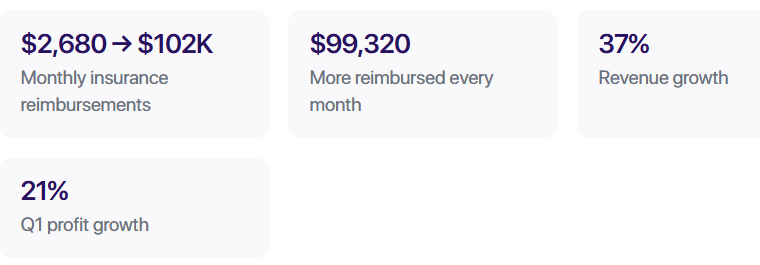
The clearest evidence of what a connected billing and collections system does for a clinic's revenue comes from First Rehabilitation, a three location outpatient rehab group in Palm Beach County, Florida. The clinic's move to SPRY was covered by Healthcare IT News in a feature by senior editor Bill Siwicki, who reported the following results after First Rehabilitation moved off disconnected systems, paper heavy billing, and outside billing fees:
- Revenue up 37 percent, with Q1 profit up 21 percent year over year
- Monthly insurance reimbursements climbed from $2,680 to $102,000
- Evaluation note time dropped from 30 to 40 minutes down to 5 minutes
- Cancellation rate fell from 17 percent to 7.5 percent
As Nick Kashuba, COO of First Rehabilitation, put it in the article: "Now, everything lives in one place, and the visibility is immediate."
That visibility is the point. When a clinic can see patient balances, insurance payments, and denials in a single billing dashboard, staff spend less time chasing information across systems and more time actually collecting.
Patient Collections Software vs a Standalone Payment Processor
It is worth being direct about the difference, since many clinics already use a payment processor and assume that covers patient collections:
A payment processor solves how money moves. Patient collections software solves who owes what, when to ask, and where that information lives once collected. For a clinic already running billing and RCM in one platform, adding collections to the same system removes an entire category of manual reconciliation.
Frequently Asked Questions
What is patient collections software?
Patient collections software is a system that tracks what patients owe a healthcare practice, calculates that responsibility before or at the time of service, and provides tools like card on file, payment links, and payment plans to collect it, with payments recorded directly against the patient's account.
How is patient collections software different from billing software?
Billing software generally focuses on the claims process with insurance payers, including coding, claim submission, and denial follow up. Patient collections software focuses on the portion of the bill the patient owes directly. The two work best when they are part of the same platform, since a patient's total balance depends on what the payer has already covered.
Why do PT clinics need pre visit cost estimates?
Because collection rates drop sharply once a patient leaves the clinic. Research cited by HFMA puts the odds of collecting a balance at roughly 70 percent when asked before or at the time of service, compared with about 30 percent after the visit. A pre visit estimate lets front desk staff have that conversation while the odds are still in the clinic's favor.
Does card on file work for physical therapy clinics with recurring visits?
Yes. Because PT, OT, and SLP patients typically return for multiple visits over a plan of care, storing a card securely lets a clinic collect a copay or balance at each visit without asking the patient to re enter payment details every time, or without needing to invoice separately after each session.
Is patient payment data secure in an integrated system?
It should be. Look for PCI compliance on the payment processing side and HIPAA compliance across the platform handling the patient record. SPRY's payments integration through FortisPay is built to meet both standards, so payment data does not sit in a less secure system outside the clinic's normal compliance environment.
Reduce costs and improve your reimbursement rate with a modern, all-in-one clinic management software.
Get a DemoLegal Disclosure:- Comparative information presented reflects our records as of Nov 2025. Product features, pricing, and availability for both our products and competitors' offerings may change over time. Statements about competitors are based on publicly available information, market research, and customer feedback; supporting documentation and sources are available upon request. Performance metrics and customer outcomes represent reported experiences that may vary based on facility configuration, existing workflows, staff adoption, and payer mix. We recommend conducting your own due diligence and verifying current features, pricing, and capabilities directly with each vendor when making software evaluation decisions. This content is for informational purposes only and does not constitute legal, financial, or business advice.