
This guide compares credentialing software for PT, OT, and SLP clinics, using the $2.1 billion healthcare organizations spend annually on credentialing as the backdrop. Its key differentiator is coverage of the interstate licensure compacts specific to rehab therapy: the mature PT Compact, the newly live OT Compact, and the ASLP-IC for speech-language pathology, none of which general credentialing content addresses. A comparison table shows SPRY offering full native credentialing automation, while neither WebPT nor Prompt EMR offer this natively. SPRY's five-step process is detailed end-to-end, backed by verified results (40% fewer denials, 30% faster reimbursements, 60% less admin work).
What Is the Best Credentialing Software for PT, OT, and SLP Clinics?
For most outpatient rehab practices, credentialing software works best when it's built around payer enrollment specifically, not general healthcare compliance and training bundled with credentialing as an afterthought. SPRY automates the full credentialing lifecycle, application, verification, payer contracting, and ongoing tracking, with free credentialing included for up to 5 payers on its billing service tier. MedTrainer bundles credentialing with a learning management system, best suited to larger organizations already using it for compliance training. Modio Health focuses specifically on credentialing and license tracking, with strong user satisfaction scores but less integration with billing and claims than a platform built specifically for rehab therapy.
Why Does Credentialing Take So Long, and What Does the Delay Actually Cost?
Healthcare organizations spend over $2.1 billion annually on credentialing activities industry-wide, and the average provider takes 90 to 120 days to complete the process. For a rehab therapy clinic, every one of those days is a provider who's hired, trained, and ready to see patients, but can't bill insurance for their work yet.
That delay compounds specifically for growing practices. A clinic adding a new provider isn't just managing one credentialing file; it's managing that file alongside every existing provider's re-credentialing cycle, license renewals, and CAQH re-attestations, all running on different timelines with different payers.
Do PT, OT, and SLP Licenses Actually Transfer Across State Lines?
This is where credentialing software for rehab therapy specifically needs to do something general healthcare credentialing tools don't: track compact privileges, not just single-state licenses.
Source: OT Compact press release (Indiana Professional Licensing Agency, March 2026); ASHA, "Interstate Compact Moves Closer to Rollout"; see references
The practical implication: a therapist can now hold compact privilege to practice in multiple states without a full separate license in each one, but a compact privilege still has to be tracked, renewed, and matched to the correct payer enrollment in every state where a clinic operates. Credentialing software built for general healthcare (hospitals, physician groups) often has no concept of a compact privilege at all, since physicians and most other healthcare disciplines don't have an equivalent multi-state system.
What to Look for in Credentialing Software?
Does it track compact privileges separately from full state licenses?
A tool that only tracks "licensed in State X: yes/no" will miss the distinction between a full license and a compact privilege, which have different renewal cycles and documentation requirements.
Does it sync with CAQH ProView, or require manual re-entry?
CAQH is the industry-standard provider data source most payers pull from. Software that only partially syncs, or requires manual reconciliation on top of CAQH data, defeats much of the point of automation.
Does it handle payer contracting after approval, not just the application?
Getting approved is only half the process. Once a payer approves enrollment, a contract still has to be sent, signed, and coordinated before a provider can actually bill that payer.
Does it track re-credentialing and expiration dates proactively, or only when something lapses?
Re-credentialing is not a one-time event. Software that surfaces upcoming expirations before they become a lapse prevents the exact gap that stops a provider from billing.
Is credentialing connected to billing, or a separate system entirely?
A credentialed provider who isn't correctly linked to billing and claims submission can still generate denials, even after a successful credentialing process, if the two systems don't share data.
How SPRY's Credentialing Works
SPRY's own credentialing page describes its approach across five specific capabilities, worth using as a direct checklist against any vendor, not just SPRY.
Personalized Credentialing Automation. "Whether you're a solo provider or a growing group, SPRY customizes your credentialing process to accelerate payer enrollment." The process scales rather than forcing a clinic to switch tools as it grows.
Comprehensive Credential Tracking. "Track every step, from submission to approval. Avoid missed deadlines and stay ahead of expirations with real-time status updates and renewal alerts."
Seamless Verification. "SPRY verifies licenses, education, work history, and certifications instantly with trusted sources, reducing compliance risks and errors." Verification runs against actual primary sources, not self-reported data.
Payer Enrollment, Handled for You. "From submitting the right application to following up with payers, SPRY manages the entire process so you stay focused on patients, not paperwork." This covers the payer follow-up work, not just the initial application.
Field-Specific Expertise. "Built for therapy clinics, SPRY ensures credentialing flows smoothly for physical therapists, occupational therapists, and speech-language pathologists, solo or under group NPI."
SPRY vs WebPT vs Prompt vs MedTrainer vs Modio Health: Credentialing Software Compared
How SPRY Automates Credentialing: Five Steps, Start to Approval
SPRY's credentialing workflow is built around a fixed five-step process, removing the manual coordination work that typically stretches credentialing across months.
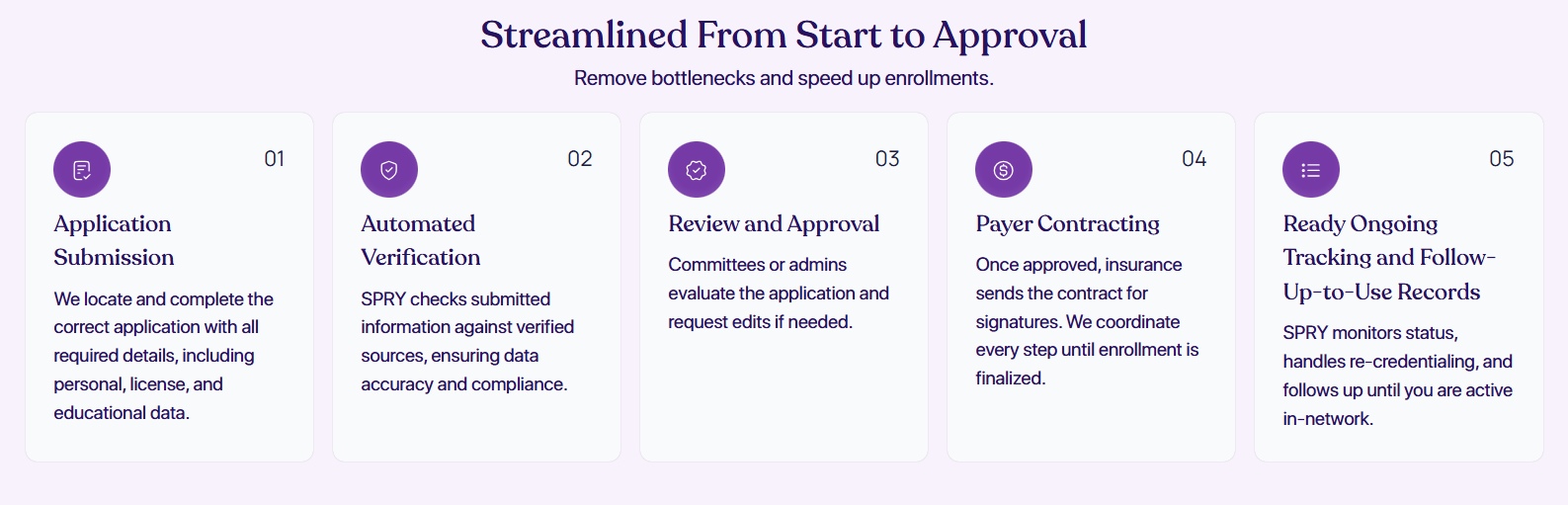
The fifth step is the one most credentialing processes skip entirely: most tools stop tracking once a provider is approved. SPRY's process treats approval as the midpoint, not the finish line, since re-credentialing, license and compact privilege renewals, and CAQH re-attestation all have to keep happening on their own schedules indefinitely.
Verified Results
"SPRY is an intuitive system that integrates everything I need into one space, giving me more time with patients and less time on the computer."— Jordan Matthew Blake Wright, Clinic Director, Integumentary Physiotherapy Clinic
"SPRY simplifies documentation and offers superb customer service. It's a clean, clutter-free EMR — after 3 different systems, we finally have one that works for us."— Nilma Elias, Revenue Operations, OC Sports and Rehab
Frequently Asked Questions
What is credentialing software?
Software that manages the process of enrolling a healthcare provider with insurance payers, including application submission, primary source verification, payer contracting, and ongoing re-credentialing tracking.
How long does provider credentialing normally take?
Industry-wide, the average provider takes 90 to 120 days to complete credentialing, though this varies by payer and state.
Do PT, OT, and SLP compact privileges need to be credentialed separately from a full license?
Yes. A compact privilege has its own documentation and renewal requirements distinct from a full state license, and payer enrollment still needs to reflect the correct authorization type for each state a provider practices in.
Does credentialing software replace CAQH?
No. CAQH ProView is the underlying data source most payers pull from. Credentialing software should sync with CAQH to reduce duplicate data entry, not replace it entirely.
What happens if a provider's credentialing lapses?
A lapsed credential typically means claims submitted under that provider can be denied until re-credentialing is complete, which is why proactive tracking of expiration and renewal dates matters as much as the initial application.
Is credentialing the same as licensing?
No. Licensing is a state-issued authorization to practice. Credentialing is the separate process of enrolling that licensed provider with specific insurance payers so their services can be billed and reimbursed.
Ready to Stop Manually Tracking Credentialing Deadlines?
If your team is still tracking license renewals, compact privileges, and re-credentialing dates across spreadsheets, SPRY's team can walk through what automated credentialing would look like for your clinic.
Reduce costs and improve your reimbursement rate with a modern, all-in-one clinic management software.
Get a DemoLegal Disclosure:- Comparative information presented reflects our records as of Nov 2025. Product features, pricing, and availability for both our products and competitors' offerings may change over time. Statements about competitors are based on publicly available information, market research, and customer feedback; supporting documentation and sources are available upon request. Performance metrics and customer outcomes represent reported experiences that may vary based on facility configuration, existing workflows, staff adoption, and payer mix. We recommend conducting your own due diligence and verifying current features, pricing, and capabilities directly with each vendor when making software evaluation decisions. This content is for informational purposes only and does not constitute legal, financial, or business advice.