




This guide compares five home exercise program platforms for PT clinics: SPRY (integrated with Wibbi), Physitrack, MedBridge, WebPT, and Exercise Pro Live, on exercise library size, documentation integration, patient app requirements, multilingual support, and pricing. It is anchored by the well-documented finding that patients forget 40% to 80% of verbal clinical instructions, making HEP delivery a driver of adherence rather than a convenience feature. SPRY assigns exercises directly from patient notes with a 5,000+ exercise library plus access to Wibbi's evidence-based protocols, delivered by email or printed handout with no patient app required, and reports a 90% increase in patient engagement on its own platform. Physitrack carries the largest standalone library at 18,000+ exercises across 15+ languages, MedBridge bundles HEP with staff continuing education, WebPT includes HEP inside its broader EMR, and Exercise Pro Live offers a dedicated, video-first tool with per-user subscription pricing. Vendor-stated competitor figures are marked accordingly rather than presented as independently verified.
What Is the Best Home Exercise Program Software for a PT Clinic?
The best home exercise program (HEP) software depends on which trade-off matters most for a clinic: documentation integration, library depth, or bundled extras. Five platforms come up most often in 2026. SPRY, integrated with Wibbi, assigns exercises directly from patient notes, combining a 5,000+ exercise library with access to Wibbi's evidence-based protocols and delivery by email or printed handout, no patient app required. Physitrack carries the largest standalone library, at 18,000+ exercises across 15+ languages. MedBridge bundles HEP with a continuing education platform, which matters most to health systems already using it for staff training. WebPT includes HEP as a feature inside its broader EMR rather than selling it separately. Exercise Pro Live is a dedicated, video-first HEP tool built around predictable subscription pricing. The right fit comes down to what's already part of the clinic's documentation workflow.
Why Does HEP Software Matter? Most Patients Forget What They're Told
Written, visual home exercise guidance isn't a nice-to-have, it's compensating for a well-documented gap in verbal instruction retention. Patients forget an estimated 40% to 80% of what's said to them verbally during a clinical visit, which is exactly why a clear video and written program, accessible after the patient leaves, has a direct impact on whether the prescribed exercises actually get done.
This is the real business case for HEP software: adherence isn't just a clinical outcome, it's tied directly to whether a patient sees enough progress to keep showing up, and whether the plan of care documentation actually supports what was billed.
What to Look for When Comparing HEP Platforms
Is it built into the documentation workflow, or a separate system?
A HEP tool that requires switching tabs or logging into a separate platform adds friction that a busy clinician will eventually skip on a rushed day.
Does it support delivery without requiring the patient to download an app?
A program that only works through a dedicated app creates a real adoption barrier, especially for older patients or those less comfortable with new software.
Does it suggest progression exercises automatically, or require manual updates every visit?
Smart suggestions based on recovery stage save real time across a full caseload compared to manually selecting new exercises at every visit.
How large and clinically credible is the underlying exercise library?
A library with a few hundred generic exercises limits how specific a program can be to a patient's actual condition. A library in the thousands, covering multiple specialties, supports more individualized programs.
Is pricing per-prescription, tiered, or a flat subscription?
Usage-based pricing can create unpredictable costs at higher patient volumes, while a flat model scales more predictably.
Most of this list applies the same way across PT and OT caseloads, since both disciplines prescribe home exercise and functional practice programs. SLP-focused practices typically look for comparable functionality in a home speech and language practice tool rather than an exercise library, so the platforms below are most relevant to PT and OT operations.
SPRY vs Physitrack vs MedBridge vs WebPT vs Exercise Pro Live at a Glance
Figures marked "vendor-stated" come directly from each company's own published materials, not independent verification. Rows marked "not publicly documented" reflect an absence of public information, not a confirmed absence of the capability. Confirm current details directly with each vendor before purchase.
1. SPRY + Wibbi: Built Directly Into the Patient Chart
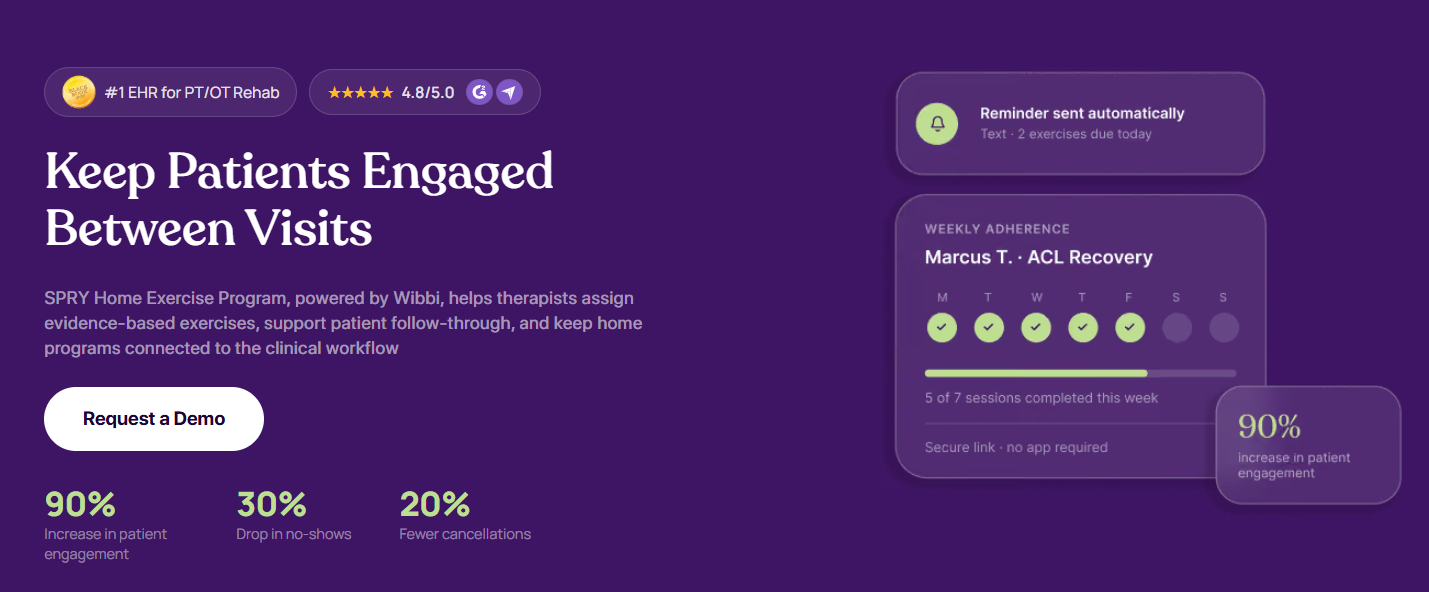
Best for: clinics that want home exercise programs assigned from the same screen as documentation, with no second login.
SPRY's home exercise program, powered by Wibbi, lets therapists assign exercises directly from patient notes rather than a separate tool: browse and assign from inside the chart, pull from evidence-based exercise and education content, customize and save clinic-specific protocols for reuse, send the program digitally by email or as a printed handout, and keep it aligned to the patient's goals and plan of care as they progress. The library includes 5,000+ exercises with smart suggestions for progression exercises based on the patient's recovery and clinical parameters, and home exercise program access is included in SPRY's standard subscription rather than sold as a separate add-on.
SPRY reports a 90% increase in patient engagement, a 30% drop in no-shows, a 20% reduction in cancellations, and 20+ minutes saved per patient for staff among clinics using its HEP (self-reported on SPRY's own platform, not independently audited).
Through the Wibbi integration, clinics also get hundreds of pre-built, evidence-based rehab protocols, clinic-branded document templates, and multilingual patient materials in English, French, and more, without leaving the SPRY workflow. Wibbi itself, as a standalone platform outside the SPRY integration, maintains a library of 20,000+ multi-disciplinary exercise videos across 18+ specialties and is used by more than 40,000 health specialists across 8,000+ organizations (vendor-stated, describing Wibbi's full platform rather than what's exposed specifically inside SPRY).
Independent, unaffiliated feedback on Wibbi, published outside any SPRY relationship, describes it as a platform that "looks professional, saves our therapists time," from a physical therapy practice that has used the software since 2010.
2. Physitrack
Best for: clinics or health systems that want the deepest exercise library and multilingual delivery, and are comfortable running it alongside a separate EMR.
Physitrack publishes an exercise library of 18,000+ videos, delivered to patients across 15+ languages through its PhysiApp, which the company reports is used by more than 110,000 clinicians across 180+ countries (vendor-stated). Physitrack connects to a range of EMRs, including Epic, but runs as its own platform rather than being built into any single documentation system, so clinicians move between two systems to prescribe and chart. Pricing isn't published; plans are quote-based through Physitrack's sales team.
3. MedBridge
Best for: health systems already using MedBridge for staff CEUs that want HEP delivery inside the same subscription.
MedBridge pairs its HEP builder and the free Medbridge GO patient app with a continuing education platform covering CEUs and compliance training, which is the platform's main differentiator over dedicated HEP tools. Group plans that include the HEP builder start near $169 per seat, per year (vendor-stated); individual plans that bundle HEP with CEUs are priced higher and shift with promotional offers, so current numbers are worth confirming directly with MedBridge before budgeting. MedBridge does not publish the size of its exercise library.
4. WebPT
Best for: practices already running WebPT as their core EMR that want HEP in the same system rather than adding a second tool.
WebPT's HEP is not documented as a standalone product; it's a feature inside WebPT's broader EMR and PXM platform, built around a library the company describes as 5,500+ photo and video exercises, delivered to patients through its StriveHub portal or by email in up to 8 languages (vendor-stated). Because it's bundled into the EMR rather than sold separately, HEP through WebPT is typically only a relevant comparison point for clinics already using, or actively evaluating, WebPT as their core documentation system.
5. Exercise Pro Live
Best for: clinics that want a standalone HEP tool with predictable, per-user subscription pricing rather than usage-based fees.
Exercise Pro Live is built specifically around HEP and remote therapeutic monitoring, with an HD video exercise library the company lists at 3,700+ exercises, patient and clinician mobile apps, and printed handout support (vendor-stated). Plans are tiered by user count and start around $16.99 per user, per month, with the vendor marketing flat subscription pricing rather than per-patient charges as a core differentiator. It integrates with a range of EMR and EHR systems rather than functioning as one itself.
What Does HEP Software Cost?
Pricing structures vary more than feature lists do. SPRY includes home exercise program access inside its standard subscription, which starts at $79 per provider, per month, with no separate HEP fee. Physitrack and Exercise Pro Live use different models entirely: Physitrack keeps its pricing quote-only through a sales conversation, while Exercise Pro Live publishes a starting rate around $16.99 per user, per month, on a tiered, per-user subscription (vendor-stated). MedBridge's group plans that include the HEP builder start near $169 per seat, per year, but individual plans and current promotional pricing change often enough that they're worth confirming directly with MedBridge before budgeting (vendor-stated). WebPT does not sell HEP as a line item at all, it's bundled into whatever EMR plan a clinic is already on. Confirm all vendor pricing directly before using it in a buying decision, since subscription tiers and promotional rates shift throughout the year.
HEP Software Evaluation Checklist
- Confirm the software assigns exercises directly from clinical documentation, not a separate tool
- Check whether patients need to download an app, or can access programs via a direct link
- Review the exercise library size and specialty coverage against your actual patient population
- Ask whether progression suggestions are automated or require manual selection every visit
- Confirm custom program templates can be saved and reused across similar patients
- Check whether adherence and progress tracking data feeds back into the patient's chart automatically
- Confirm whether pricing is flat, tiered, or usage-based, and how that scales at your patient volume
- Confirm multilingual support if your patient population needs materials in languages other than English
Frequently Asked Questions
What is home exercise program (HEP) software?
Software that lets a clinician prescribe and deliver exercise programs to patients for completion outside the clinic, typically including a video and instruction library, progress tracking, and a delivery method like email, text, or a patient app.
Why does HEP software matter for patient outcomes?
Patients forget an estimated 40% to 80% of verbal instructions given during a visit. Written and visual home exercise guidance is what actually supports adherence between appointments.
Does home exercise program software require patients to download an app?
It depends on the platform. SPRY delivers programs by email or as a printed handout without a separate app. Physitrack, MedBridge, and Exercise Pro Live all offer dedicated patient apps as an access option, and WebPT delivers through its StriveHub portal.
Is Physitrack or MedBridge the better fit for a PT clinic?
It depends on priorities. Physitrack publishes a larger exercise library and broader multilingual support, while MedBridge's main advantage is bundling HEP with a continuing education platform, which matters specifically for health systems already invested in that ecosystem. Confirm current specifics directly with each vendor.
Does WebPT offer home exercise program software?
WebPT includes an HEP feature as part of its broader EMR platform rather than offering it as a standalone product, so it's typically only relevant if a practice is already using WebPT as its core EMR.
How large should a home exercise program's exercise library be?
There's no universal number, but a library covering multiple specialties and conditions in the thousands, rather than a few hundred generic exercises, supports more individualized, condition-specific programs.
Ready to See What Built-In HEP Actually Looks Like?
If your team is managing home exercise programs through a separate tool or paper handouts, SPRY's team can walk through what assigning exercises directly from documentation would look like for your clinic.
Reduce costs and improve your reimbursement rate with a modern, all-in-one clinic management software.
Get a DemoLegal Disclosure:- Comparative information presented reflects our records as of Nov 2025. Product features, pricing, and availability for both our products and competitors' offerings may change over time. Statements about competitors are based on publicly available information, market research, and customer feedback; supporting documentation and sources are available upon request. Performance metrics and customer outcomes represent reported experiences that may vary based on facility configuration, existing workflows, staff adoption, and payer mix. We recommend conducting your own due diligence and verifying current features, pricing, and capabilities directly with each vendor when making software evaluation decisions. This content is for informational purposes only and does not constitute legal, financial, or business advice.

