
This guide quantifies what prior authorization delays actually cost a rehab therapy clinic, both in cancelled visits and a more hidden problem: a real 2026 study analyzing 158,000 PT, OT, and SLP authorization requests found outright denials at just 0.9%, but 1 in 6 requests came back partially approved with fewer sessions than prescribed, roughly 15.3% for PT specifically, a reduction that never appears in denial-rate reporting since it's technically an approval. It also covers AMA survey data showing 94% of physicians report care delays from prior authorization and nearly 4 in 5 report patients abandoning treatment entirely because of it. Only about 1 in 5 denied authorizations are ever appealed, primarily due to low confidence in success or insufficient staff time. SPRY's AI-driven prior authorization workflow processes requests up to a week before a scheduled visit, with clinics on the platform reporting zero authorization-related cancellations for months at a time.
How Much Does a Prior Authorization Delay Actually Cost a Clinic?
More than the administrative time it takes to track, though that time cost is real too. Industry-wide, physicians and their staff spend an average of 13 hours a week managing prior authorization requests, according to AMA survey data, and 94% report that prior authorization causes delays in patient care. For a rehab therapy clinic specifically, the sharper cost is what happens when an authorization isn't resolved before a scheduled visit: the appointment gets cancelled, the slot goes unfilled, and that revenue doesn't get recovered just because the authorization eventually clears.
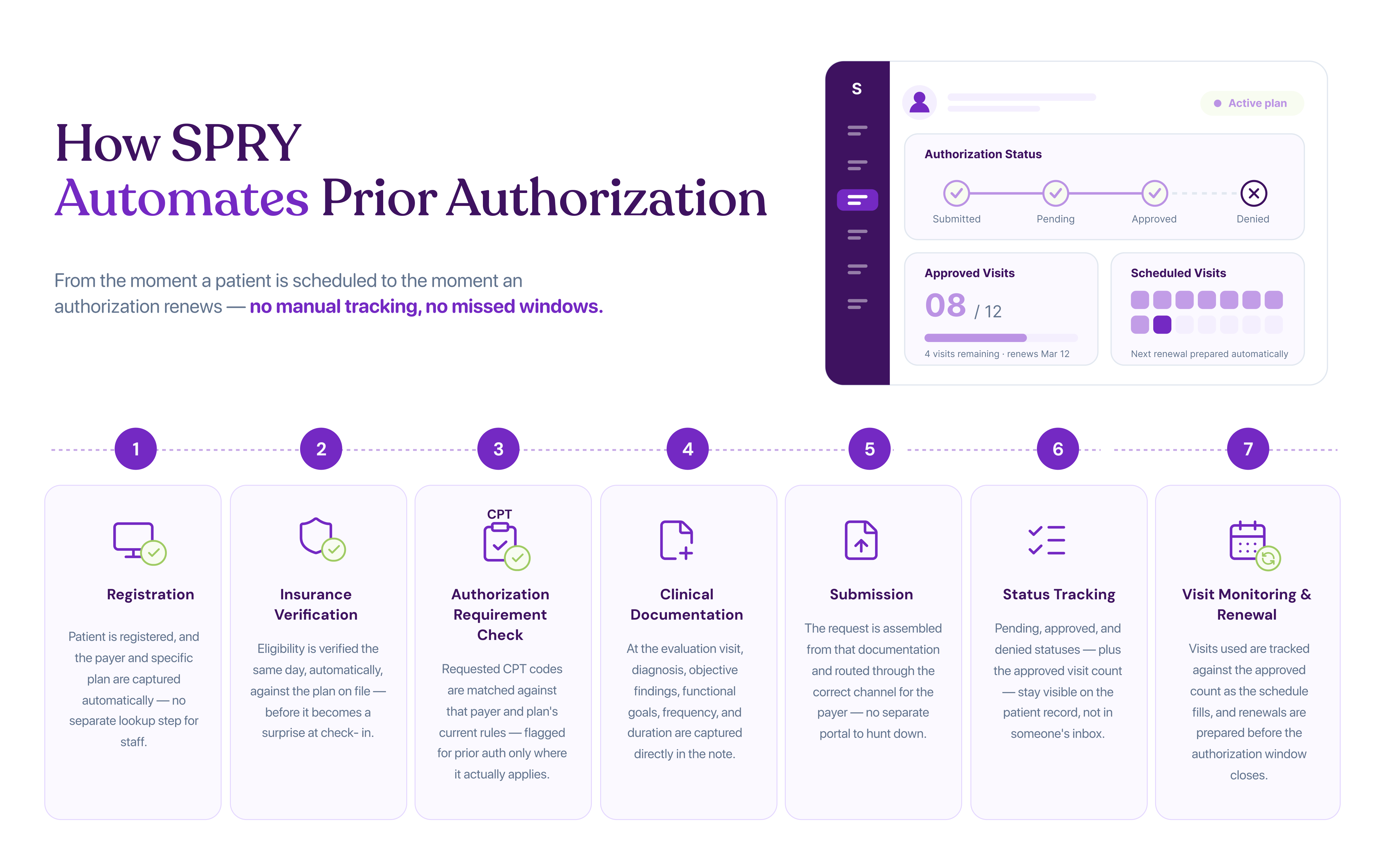
SPRY's prior authorization workflow processes authorizations up to a week before a scheduled appointment, specifically to resolve discrepancies before the patient walks in rather than finding out the visit can't proceed at check-in.
What a Cancelled Visit Actually Costs, Beyond the Missed Appointment
A cancellation caused by a missing or delayed authorization isn't just an inconvenience, it's a specific, calculable revenue loss. The slot was scheduled, the provider was staffed for it, and if it can't be filled on short notice, that revenue is gone for the day rather than delayed.
The administrative cost compounds on top of the lost visit revenue. Nearly a third of physicians report having staff dedicated exclusively to prior authorization work, and industry-wide, practices spend an average of 13 hours a week on authorization requests across physicians and staff combined, time that produces no billable revenue on its own, it only protects revenue that's already been scheduled.
The Hidden Problem That Doesn't Show Up in Any Denial Report
A real, dated study released in June 2026 by Silna, analyzing 158,000 actual prior authorization requests for physical therapy, occupational therapy, and speech therapy across two of the largest Medicare Advantage payers, found something most denial-rate reporting completely misses. The outright denial rate across those requests was just 0.9%, low enough that a clinic tracking only denials would assume authorization isn't a meaningful problem.
But 1 in 6 requests came back approved with fewer therapy sessions than the physician originally prescribed, a partial approval rather than a denial. Because it's technically an approval, it never appears in denial rate reports, payers aren't required to disclose it, and providers can't appeal it the way they would a denial. It registers as a successful authorization in every metric the industry uses, while the patient receives less care than was actually ordered, and the clinic loses the revenue from every session that was cut.
The rate was nearly identical across all three rehab disciplines:
For a plan of care written for 20 sessions, a reduction to 12 doesn't just mean less revenue on paper, it means a clinic has to either absorb the clinical risk of undertreating the patient or spend staff time appealing a cut that most billing systems never flagged as worth appealing in the first place, since it wasn't logged as a denial.
Why Authorization Delays Hit Harder Than a Simple Denial
A denied claim after the fact is a known, measurable cost, typically $25 to $118 to rework. A prior authorization delay is different: it risks the visit happening at all. Nearly four in five physicians report that authorization issues lead patients to abandon a recommended course of treatment entirely, not just delay it, which for a rehab therapy plan of care means a patient who may not complete the treatment that was actually prescribed.
One documented case from a dermatology practice found a median treatment delay of 12 days waiting on prior authorization, with over half of initial requests denied on first submission, consuming more than 60 administrative hours across just 50 requests. The pattern holds across specialties: the delay itself, not just the eventual outcome, is where the cost accumulates.
Why So Few Denied Authorizations Actually Get Appealed
Only about 1 in 5 physicians appeal a denied prior authorization request. The most common reason isn't that the appeal wouldn't work, it's that staff don't believe it will succeed based on past experience, and nearly half report they simply don't have the staff time to pursue it. That combination means a meaningful share of prior authorization denials are effectively absorbed as lost revenue rather than fought, the same abandonment pattern that shows up in claim denials more broadly.
How SPRY Reduces This Cost Directly
SPRY's AI-driven prior authorization workflow reads clinical documentation, completes payer questionnaires, and submits requests automatically, reducing the manual staff time that authorization work otherwise consumes. Processing authorizations up to a week ahead of a scheduled visit means discrepancies get caught and resolved before the appointment, not discovered at check-in when a cancellation is the only remaining option.
As SPRY co-founder and CEO Brijraj Bhuptani described it: clinics live on the platform have gone without a single authorization-related appointment cancellation in months, a direct measure of the exact revenue risk this problem creates.
What to Track If You Suspect Authorization Delays Are Costing You Revenue
How many appointments were cancelled or rescheduled specifically due to a missing or pending authorization in the last month?This number is often tracked loosely or not at all, since a cancellation gets logged as a scheduling issue rather than tagged to its actual cause.
How far in advance is authorization status known relative to the scheduled visit?Authorization resolved the day of a visit leaves no room to fill a cancelled slot. Authorization resolved a week ahead gives staff time to either confirm the visit or proactively address the gap.
What percentage of denied authorizations get appealed versus simply abandoned?If the answer is close to the industry's roughly 1-in-5 appeal rate, a meaningful share of recoverable revenue is likely being written off by default rather than a deliberate decision.
Frequently Asked Questions
How much staff time does prior authorization typically consume?
Industry-wide, physicians and their staff spend an average of 13 hours a week on prior authorization requests, with some surveys reporting figures as high as 16 hours depending on specialty and payer mix.
What happens if a prior authorization isn't resolved before a scheduled visit?
The visit is often cancelled or rescheduled, since most payers won't cover services delivered without the required authorization in place, turning a delay into a direct, immediate revenue loss rather than just an administrative annoyance.
Why do so few denied prior authorizations get appealed?
Only about 1 in 5 physicians appeal a denied authorization, primarily because staff don't believe the appeal will succeed based on past experience, or because the practice doesn't have the staff capacity to pursue it.
Can prior authorization be processed before a patient's scheduled visit?
Yes, with the right workflow. SPRY processes authorizations up to a week before a scheduled appointment specifically to resolve issues in advance rather than at check-in.
Does automating prior authorization actually reduce cancellations?
Clinics using SPRY's automated prior authorization workflow have reported going without a single authorization-related appointment cancellation for months at a time.
What is a "partial approval," and why doesn't it show up in denial reports?
A partial approval happens when a payer authorizes fewer therapy sessions than the physician originally prescribed. Because it's technically an approval, not a denial, it doesn't appear in standard denial-rate reporting, even though it directly reduces the revenue and care a clinic was planning to deliver. A 2026 study found this affects roughly 1 in 6 PT, OT, and SLP authorization requests.
Ready to Stop Losing Scheduled Visits to Authorization Delays?
If cancelled appointments due to missing or delayed authorization are costing your clinic real, measurable revenue, SPRY's team can walk through what a week-ahead authorization workflow would look like for your specific patient volume.
Reduce costs and improve your reimbursement rate with a modern, all-in-one clinic management software.
Get a DemoLegal Disclosure:- Comparative information presented reflects our records as of Nov 2025. Product features, pricing, and availability for both our products and competitors' offerings may change over time. Statements about competitors are based on publicly available information, market research, and customer feedback; supporting documentation and sources are available upon request. Performance metrics and customer outcomes represent reported experiences that may vary based on facility configuration, existing workflows, staff adoption, and payer mix. We recommend conducting your own due diligence and verifying current features, pricing, and capabilities directly with each vendor when making software evaluation decisions. This content is for informational purposes only and does not constitute legal, financial, or business advice.