
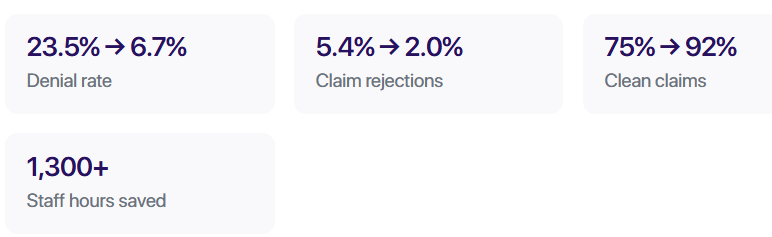
This guide compares denial management approaches for PT, OT, and SLP clinics, arguing that the strongest systems catch denials upstream — at eligibility, authorization, and documentation — rather than only scrubbing claims before submission. It backs this with real industry data (5–10% average denial rates, $118–$181 cost per reworked denial) and a concrete example: a WebPT customer publicly requesting a feature to catch a common PT coding conflict (97140/97530 NCCI bundling) that WebPT confirmed isn't currently planned. A comparison table covers SPRY, WebPT, Raintree, Prompt EMR, and Jane App on billing model, claim scrubbing depth, and PT-specific automation. SPRY's own results are detailed with verified stats (40% fewer denials, 2.0% denial rate across managed clinics) and named customer proof, including CAM Physical Therapy's before-and-after results (denial rate 23.5% to 6.7%, clean claims 75% to 92%, 1,300+ staff hours saved) and a case study showing prior-authorization processing time dropping from 30 minutes to seconds after migrating to SPRY.
What Is the Best Denial Management Software for PT Clinics?
For most outpatient rehab practices, denial management works best as a built-in part of your EMR and billing platform, not a bolt-on tool, because most denials start upstream of billing, in eligibility checks, prior authorization, and documentation. SPRY is the most complete option for PT specifically, connecting eligibility, authorization, documentation, and claim scrubbing into one workflow with a verified 2.0% denial rate and 98%+ clean claim rate across managed clinics. WebPT and Raintree both offer solid built-in claim scrubbing for practices already on those platforms, while Prompt EMR uses AI-flagged coding checks. Enterprise-only, non-PT-specific tools like Waystar and Experian Health exist but aren't built for rehab therapy's specific rules (8-minute rule, KX modifiers, plan-of-care compliance).
Why Denial Management Matters More Than It Looks Like It Should?
Claim denials aren't a rounding error; they're a real, recurring cost with numbers behind them:
The pattern worth noticing: nearly half of all denials (documentation + eligibility, ~47% combined) happen before a claim is ever submitted. That's exactly why SPRY frames denial management as starting at intake and scheduling, not at the billing desk, a philosophy that shows up across its RCM and denial management pages.
What to Look for in Denial Management Software?
SPRY's own approach to denial management is built around a simple observation: most denials are created long before a biller ever sees the claim. That framing is a useful checklist for evaluating any platform, not just SPRY:
Does it catch issues upstream — before the claim is submitted?
Eligibility gaps, missing authorization, weak documentation, coding issues, modifier errors, and payer-rule misses all create denial risk before billing ever touches the claim. A system that only scrubs at submission time is already too late for a large share of denials.
Does it give billing staff full context without making them hunt for it?
When denials are worked outside the clinical and scheduling workflow, billers have to chase down notes, authorization details, visit history, and payer rules across separate systems. Context should travel with the claim, not require a separate investigation.
Does it categorize denial reasons and connect them to root cause?
A denial queue that isn't tagged back to its source (an expired authorization, a documentation gap, a coding error) just means staff keep fixing the same underlying problem one claim at a time instead of fixing the workflow.
Does it apply PT/OT/SLP-specific rules, not generic medical claim logic?
Rehab therapy has its own denial triggers — 8-minute rule compliance, KX modifier thresholds, and NCCI bundling edits between commonly co-billed codes like 97140 and 97530. A scrubber built for general medical billing often misses these entirely.
Denial Management Software Comparison
SPRY's Approach: Denial Management That Starts Before the Claim Exists
SPRY's denial management workflow is built around a specific idea: most denials are created upstream- eligibility gaps, missing authorization, weak documentation, coding issues, modifier errors, or payer-rule misses- long before a biller ever sees the claim. Instead of treating denials as a queue to work through, SPRY connects eligibility verification, prior authorization, documentation, claim readiness, denial tracking, and payer follow-up into one workflow — so root causes get fixed, not just individual claims.
Verified Results
What Real Clinics Say
"Before SPRY, one person handled benefits and authorization for all six locations and did not have time to verify every single visit. Now with SPRY, we get daily verification. Every morning when we come in, we already know the benefits for every single one of our patients. That helps us stop visits before they become rejections."
— Janesa Paver, VP of Finance, CAM Physical Therapy
"SPRY's RCM services have significantly improved our collections and decreased our AR. We've seen fewer denials and faster billing-to-collection times."
— Ken McKenzie, Clinic Owner, PrimeTime Chiropractic
"I really enjoy the convenience of having billing and documentation all in one system. Claims are billed out in real time, and I can quickly see if there are any denials. The ability to set rules for different payers helps reduce denials and improves efficiency."
— SPRY customer, sprypt.com/feature/rcm
Real Migration Proof: Motion PT
For a concrete before/after on prior authorization specifically — one of the biggest upstream denial drivers — see Motion PT's migration to SPRY, where pre-authorization processing time dropped from 30 minutes per request to seconds using SPRY's Quick Auth API, directly addressing the authorization-related denials that had been causing revenue leakage.
Common Denial Codes Worth Understanding
If you're troubleshooting recurring denials right now rather than evaluating new software, SPRY maintains a growing library of denial-code-specific guides, including:
- Denial Code CO-29 — timely filing limit issues
- Denial Code CO-50 — medical necessity documentation gaps
Both illustrate the same pattern: most recurring denial codes trace back to a workflow issue (missed deadlines, incomplete documentation) rather than a one-off billing mistake — which is the whole argument for root-cause-based denial management over a simple claim scrubber.
Frequently Asked Questions
What is denial management software?
Denial management software tracks why insurance claims are rejected, helps billing teams work and appeal those denials, and — in more complete systems — identifies the upstream cause (eligibility, authorization, documentation, coding) so the same denial doesn't keep recurring.
Is denial management the same as claim scrubbing?
No. Claim scrubbing checks a claim for errors before submission. Denial management covers what happens after a claim is rejected — tracking the reason, prioritizing which denials to work first, managing appeals, and ideally feeding that information back to prevent the same issue from causing future denials.
What's the average claim denial rate for PT/OT/SLP practices?
Industry-wide, physician and outpatient practices see denial rates of 5–10% of all charges. SPRY's managed clinics average a 2.0% denial rate, achieved through upstream prevention rather than after-the-fact appeals.
Do I need a separate denial management tool, or should it be built into my EMR?
For PT/OT/SLP specifically, an integrated approach tends to outperform a standalone tool, since most denials originate in clinical and scheduling workflows (missing authorization, documentation gaps) that a billing-only tool never sees.
Does denial management software replace my billing staff?
No. It's designed to give billing staff context — why a claim was denied, what caused it, and what to do next — rather than requiring them to manually investigate each one from scratch.
What PT-specific coding issues should denial management software catch?
At minimum: 8-minute rule compliance, KX modifier thresholds for therapy caps, and NCCI bundling edits between commonly co-billed codes like 97140 and 97530.
Ready to Reduce Denials Before They Happen?
If your team is still working denials as a disconnected queue instead of catching them upstream, SPRY's team can walk through how the denial management workflow would fit your clinic's specific payer mix.
Reduce costs and improve your reimbursement rate with a modern, all-in-one clinic management software.
Get a DemoLegal Disclosure:- Comparative information presented reflects our records as of Nov 2025. Product features, pricing, and availability for both our products and competitors' offerings may change over time. Statements about competitors are based on publicly available information, market research, and customer feedback; supporting documentation and sources are available upon request. Performance metrics and customer outcomes represent reported experiences that may vary based on facility configuration, existing workflows, staff adoption, and payer mix. We recommend conducting your own due diligence and verifying current features, pricing, and capabilities directly with each vendor when making software evaluation decisions. This content is for informational purposes only and does not constitute legal, financial, or business advice.